Tuesday, May 31, 2005
Microsoft
I want to take a look at Microsoft's monthly chart and see if I can guess some reasonable price targets for MSFT using divisions of the historical range and price boxes.
I've chosen to work with the divisions of the all time high of 54.81 since the only reasonable historical low in this stock is essentially 0 adjusted for splits. These divisions are displayed as blue lines on the monthly chart. The bull market boxes for MSFT are displayed in red and are 16.40 points high.
From its all time high of 54.81 in December 1999 MSFT dropped to 18.39 in December 2000, very near 1/3 of the all time high at 18.25. My rule in these situations is that the subsequent rally will typically carry to the corresponding 2/3 point which in this case is at 36.54. In the event MSFT managed to advance to a high of 34.79 in June 2001. The final phase of the 2000-2002 bear market in the broad averages then carried MSFT down to 18.93, a second low near the 1/3 division point, in July 2002.
Since that second low MSFT has traded in a narrow range whose highs have been very near 27.41 which is 1/2 the all time high. I am bullish on the broader averages and on the Nasdaq Composite so I expect MSFT to break above this 1/2 point soon. It has been 3 years since the July 2002 low so any such breakout should be followed by an extended upmove.
The next step up from the 2/3 division point which stopped the rally from the 2000 low is the 3/4 point at 41.11. Note also that the 1/2 point of the second box is at 43.00 and this is normally strong resistance. So as my target for MSFT over the next 6-9 months I choose the 41-43 range.
I've chosen to work with the divisions of the all time high of 54.81 since the only reasonable historical low in this stock is essentially 0 adjusted for splits. These divisions are displayed as blue lines on the monthly chart. The bull market boxes for MSFT are displayed in red and are 16.40 points high.
From its all time high of 54.81 in December 1999 MSFT dropped to 18.39 in December 2000, very near 1/3 of the all time high at 18.25. My rule in these situations is that the subsequent rally will typically carry to the corresponding 2/3 point which in this case is at 36.54. In the event MSFT managed to advance to a high of 34.79 in June 2001. The final phase of the 2000-2002 bear market in the broad averages then carried MSFT down to 18.93, a second low near the 1/3 division point, in July 2002.
Since that second low MSFT has traded in a narrow range whose highs have been very near 27.41 which is 1/2 the all time high. I am bullish on the broader averages and on the Nasdaq Composite so I expect MSFT to break above this 1/2 point soon. It has been 3 years since the July 2002 low so any such breakout should be followed by an extended upmove.
The next step up from the 2/3 division point which stopped the rally from the 2000 low is the 3/4 point at 41.11. Note also that the 1/2 point of the second box is at 43.00 and this is normally strong resistance. So as my target for MSFT over the next 6-9 months I choose the 41-43 range.
IBM
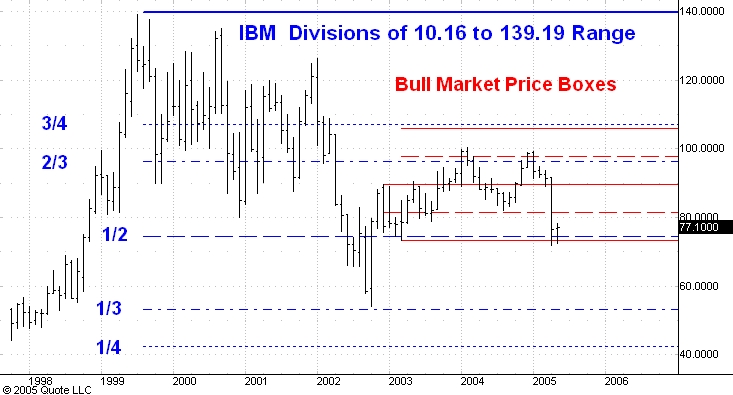
I'd like to take a look at IBM and offer a guess about its likely trend for the next six months.
In 1993 IBM dropped to a low of 10.16 (adjusted for splits) and there ended a bear market drop of more than 75% from its top in 1987. From its 1993 low IBM rallied to a high of 139.19 in 1999 and then dropped 61% to a low in 2002 of 54.01.
After a price drop of more than 50% from a high the first thing I do is take a look at the market's historical range and divide it into halves, quarters and thirds. The price levels which mark these divisions will generally prove to be support and resistance levels as long as the market stays in that range. One also can often observe symmetries in the market's price behavior relative to these divisions that have predictive value.
In the case of IBM I shall analyze the 129.03 point range that is delimited by the 10.16 low and the 139.19 high. On the monthly chart above this post I have drawn in the divisions of this range in blue and the price boxes for the bull market that began in 2002 in red.
Let's start the analysis at the 54.01 low in 2002. Notice first that the 54 low occurred close to the 1/3 level (53.17) of the range. One symmetry rule I find useful is that drops which stop at the 1/3 level are often followed by advances to the 2/3 level (96.18). I next note that there were two big rallies in the bear market from 139 to 54. The first carried IBM up 45 points and the second 46 points. A rally of 45 points from 54 would end at 99, not far above the 2/3 level. Finally the first bull market box on the monthly chart had its top at 89.46 and its low at 73.17. The 1/2 point of the second box would then be at 97.06 and is typically a strong resistance level. So a conservative guess for a target for the second leg up which started from 73.17 in March 2003 would be the 96.18 to 99 range. In the event IBM rallied as high as 100.43 in February 2004.
In April of 2005 IBM dropped to a low of 71.85. Now I am still bullish on the stock market averages and believe that they will advance substantially during the next 6 months. IBM is a prominent and widely held stock and I think it unlikely that it will drop while the broader market is advancing. I next note that the 71.85 low is near the 1/2 point (74.68) of IBM's historical range and is also the next step up from the support level at the 1/3 point which marked the 2002 low. So I conclude that IBM will now head higher with the market and the question is how high.
Well, markets typically trace out what I like to think of as "staircase patterns" relative to support and resistance levels. This means that the market typically takes two or three steps in the longer term trend direction and then reacts a step or two against this trend. This is a bull market so IBM should be climbing a staircase. It rallied two steps (past the 1/2 level and stopping at the 2/3 level) from the 54 low and then reacted one step back to the 1/2level. On this basis we would expect the rally from 71.85 to carry the market up two steps: past the 2/3 level and stopping at the 3/4level at 106.93.
Two other calculations suggest a top near 106. First note that 108 is a 100% advance from the 54 low. Second note that 107.78 is a 50% advance from the 71.85 low.
All things considered I think that 106 is a reasonable target for the uptrend in IBM which I believe began from 71.85.
In 1993 IBM dropped to a low of 10.16 (adjusted for splits) and there ended a bear market drop of more than 75% from its top in 1987. From its 1993 low IBM rallied to a high of 139.19 in 1999 and then dropped 61% to a low in 2002 of 54.01.
After a price drop of more than 50% from a high the first thing I do is take a look at the market's historical range and divide it into halves, quarters and thirds. The price levels which mark these divisions will generally prove to be support and resistance levels as long as the market stays in that range. One also can often observe symmetries in the market's price behavior relative to these divisions that have predictive value.
In the case of IBM I shall analyze the 129.03 point range that is delimited by the 10.16 low and the 139.19 high. On the monthly chart above this post I have drawn in the divisions of this range in blue and the price boxes for the bull market that began in 2002 in red.
Let's start the analysis at the 54.01 low in 2002. Notice first that the 54 low occurred close to the 1/3 level (53.17) of the range. One symmetry rule I find useful is that drops which stop at the 1/3 level are often followed by advances to the 2/3 level (96.18). I next note that there were two big rallies in the bear market from 139 to 54. The first carried IBM up 45 points and the second 46 points. A rally of 45 points from 54 would end at 99, not far above the 2/3 level. Finally the first bull market box on the monthly chart had its top at 89.46 and its low at 73.17. The 1/2 point of the second box would then be at 97.06 and is typically a strong resistance level. So a conservative guess for a target for the second leg up which started from 73.17 in March 2003 would be the 96.18 to 99 range. In the event IBM rallied as high as 100.43 in February 2004.
In April of 2005 IBM dropped to a low of 71.85. Now I am still bullish on the stock market averages and believe that they will advance substantially during the next 6 months. IBM is a prominent and widely held stock and I think it unlikely that it will drop while the broader market is advancing. I next note that the 71.85 low is near the 1/2 point (74.68) of IBM's historical range and is also the next step up from the support level at the 1/3 point which marked the 2002 low. So I conclude that IBM will now head higher with the market and the question is how high.
Well, markets typically trace out what I like to think of as "staircase patterns" relative to support and resistance levels. This means that the market typically takes two or three steps in the longer term trend direction and then reacts a step or two against this trend. This is a bull market so IBM should be climbing a staircase. It rallied two steps (past the 1/2 level and stopping at the 2/3 level) from the 54 low and then reacted one step back to the 1/2level. On this basis we would expect the rally from 71.85 to carry the market up two steps: past the 2/3 level and stopping at the 3/4level at 106.93.
Two other calculations suggest a top near 106. First note that 108 is a 100% advance from the 54 low. Second note that 107.78 is a 50% advance from the 71.85 low.
All things considered I think that 106 is a reasonable target for the uptrend in IBM which I believe began from 71.85.
Monday, May 30, 2005
Google' Next Reaction
In a previous post I projected a 376 target for Google by the end of 2005. I think that public sentiment towards GOOG has been warming up but the speculative pot has definitely not yet come to the boil. Since I expect the Nasdaq and the S&P to rise quite a bit by the end of the year my 376 target for GOOG may well prove too conservative.
In any case how does one "handle" a stock like GOOG that is moving dynamically upward but is still far from a reasonable price target? In this kind of situation I want to be long and normally would not touch a long position in a stock like GOOG unless I've got good evidence that the uptrend from the IPO price of 85 is over.
But some people can't resist showing the world how smart they are and will try to sell part of their long position when a reaction seems imminent and buy it back when the reaction appears complete. How could one implement this tactic in GOOG?
The daily chart above shows my estimate of the 40 point price boxes in GOOG. The first thing to observe is that GOOG has already had two reactions on the way up one of 40 points and one of 44 points. So the next time GOOG drops about 40 points I would say that it is a strong buy. In fact, since the market is in an acceleration phase I might not even wait for the full 40 point reaction to develop but would look for a more aggressive entry after a reaction has carried 30 points and reached the 1/2 point or the top or bottom of a box.
Where might the next reaction start? Frankly, this is the hardest question to answer in speculation and I get this wrong as often as I get it right. This is why I don't like to disturb investment positions if my longer term target is still far away and if the broader market is still headed higher. In any case, let me take a stab at an answer for GOOG.
The biggest reaction in GOOG so far was 44 points from 216 to 172. The preceding move up in GOOG was 131 points from 85 to 216. If we add 131 points to the low of that reaction at 172 we get a target of 303. Notice that 302 is the 1/2 point of a price box and that the last reaction carried from one such 1/2 point to another. So my guess is that this pattern will continue and that the next reaction will start near 302 and perhaps carry as far as 262.
There is one other pattern which suggests that resistance will be found near 300. Note that 212 is 2 1/2 times the offering price of 85 and that the biggest reaction so far started from a level 4 points higher. If the next reaction starts from a level 4 points above the price which is 3 1/2 times the offering price it will begin from 301.
In any case how does one "handle" a stock like GOOG that is moving dynamically upward but is still far from a reasonable price target? In this kind of situation I want to be long and normally would not touch a long position in a stock like GOOG unless I've got good evidence that the uptrend from the IPO price of 85 is over.
But some people can't resist showing the world how smart they are and will try to sell part of their long position when a reaction seems imminent and buy it back when the reaction appears complete. How could one implement this tactic in GOOG?
The daily chart above shows my estimate of the 40 point price boxes in GOOG. The first thing to observe is that GOOG has already had two reactions on the way up one of 40 points and one of 44 points. So the next time GOOG drops about 40 points I would say that it is a strong buy. In fact, since the market is in an acceleration phase I might not even wait for the full 40 point reaction to develop but would look for a more aggressive entry after a reaction has carried 30 points and reached the 1/2 point or the top or bottom of a box.
Where might the next reaction start? Frankly, this is the hardest question to answer in speculation and I get this wrong as often as I get it right. This is why I don't like to disturb investment positions if my longer term target is still far away and if the broader market is still headed higher. In any case, let me take a stab at an answer for GOOG.
The biggest reaction in GOOG so far was 44 points from 216 to 172. The preceding move up in GOOG was 131 points from 85 to 216. If we add 131 points to the low of that reaction at 172 we get a target of 303. Notice that 302 is the 1/2 point of a price box and that the last reaction carried from one such 1/2 point to another. So my guess is that this pattern will continue and that the next reaction will start near 302 and perhaps carry as far as 262.
There is one other pattern which suggests that resistance will be found near 300. Note that 212 is 2 1/2 times the offering price of 85 and that the biggest reaction so far started from a level 4 points higher. If the next reaction starts from a level 4 points above the price which is 3 1/2 times the offering price it will begin from 301.
Friday, May 27, 2005
Nasdaq Intermediate Term Trend Projection
I'd like to make a few more comments on the weekly chart of the Nasdaq Composite index you see below.
In April 2005 the index made a low at the 1890 level and in my view another bull market upswing has begun from 1890. How far might it carry? 'There are three previous upswings in the current bull market that can be used as precedents for the current move up. The first carried the index up 37.3% from the bear market low of 1108 in October 2002 to the 1521 level two months later. The biggest of the three upswings carried the index up 71.8% from the March 2003 low of 1253 to the January 2004 high of 2153. The last upswing carried the market up 25.2% from the 1750 low in August 2004 to the 2191 high in January 2005.
If we add these percentage gains to the 1890 low of April 2005 we get upside targets of 2593, 3245 and 2365 respectively. The third target based on the percentage gain of 25.2% I think can be disregarded because the corresponding upswing was actually part of a trading range and I think the market has begun a breakout move. The first two targets correspond nicely to the targets of 2567 (50% of the 2000 high) and 3120 (1/2 point of the 1108 - 5133 range) that I cited in my last post. So I conclude that the upswing which began from the April 2005 low will in all likelihood end the bull market and terminate very near one of these two targets (probably the higher one).
In April 2005 the index made a low at the 1890 level and in my view another bull market upswing has begun from 1890. How far might it carry? 'There are three previous upswings in the current bull market that can be used as precedents for the current move up. The first carried the index up 37.3% from the bear market low of 1108 in October 2002 to the 1521 level two months later. The biggest of the three upswings carried the index up 71.8% from the March 2003 low of 1253 to the January 2004 high of 2153. The last upswing carried the market up 25.2% from the 1750 low in August 2004 to the 2191 high in January 2005.
If we add these percentage gains to the 1890 low of April 2005 we get upside targets of 2593, 3245 and 2365 respectively. The third target based on the percentage gain of 25.2% I think can be disregarded because the corresponding upswing was actually part of a trading range and I think the market has begun a breakout move. The first two targets correspond nicely to the targets of 2567 (50% of the 2000 high) and 3120 (1/2 point of the 1108 - 5133 range) that I cited in my last post. So I conclude that the upswing which began from the April 2005 low will in all likelihood end the bull market and terminate very near one of these two targets (probably the higher one).
Bull Market Boxes for the Nasdaq Composite
The weekly chart above shows the action of the Nasdaq Composite index since the bull market began in October 2002. In this post I'd like to guess how far up the index will go before this bull market ends.
The essential first step in making any forecast is to find an appropriate analogy for the current market situation. In my opinion, it is the 1929-1932 bear market in the Dow that is the closest analogy to the 2000-2002 bear market in the Nasdaq. Why? Well, the 1929-1932 bear market lasted 34 months and dropped the Dow Industrials almost 90%. The 2000-2002 bear market in the Nasdaq lasted 31 months and dropped the composite 78%.
In September 1929 the Dow industrials established a high at 381 and fell to 41 in July 1932. There were two important bull market tops during the 15 years which followed the 1932 low. The first occurred at the 195 level in the Dow in March 1937 and the second at 212 in May 1946. The significant observation here is that 195 is almost exactly 50% of the bull market top at 381 while 212 is almost exactly the 1/2 point of the range 41 - 381 of the bear market.
What are the corresponding levels for the Nasdaq Composite? This average established its bull market top in March 2000 at the 5133 level and dropped to 1108 in October 2002. We see then that 50% of the high at 5133 is 2567 and I've drawn this level as the solid black line across the chart. The 1/2 point of the 1108 - 5133 range is 3120 and this level is the solid blue line across the chart.
From this simple calculation I am willing to surmise that the bull market from the 1108 level will end either near 2567 or near 3120. My own preference is the 3120 target and I have three reasons for this. First, the 2000-2002 bear market was a smaller percentage drop in the Nasdaq than the 1929-1932 bear market was in the Dow. Second, the Nasdaq is more volatile than the Dow or S&P and I think the 3120 target is more in line with the projections I have for these other two averages. Finally, I see so much bearishness among the public that it is hard to imagine that a move only to 2567 could induce even the modest amount of bullishness that I expect to see near the bull market top.
The red lines drawn on the chart above are the bull market boxes in the average. These are 413 points high. In January of 2004 the composite bounced off of the 1/2 point of the third box and reacted to the 1/2 point of the second. In January 2005 the average again bounced off of the 1/2 point of the third box but this time dropped only to the bottom of the third box. This is a bullish sign and portends a move above the January 2005 top.
I also want to observe that the Nasdaq composite has traded sideways for more than a year now. An upside breakout from this range is likely to carry the market a long way and this is another reason for favoring the 3120 level as the target for the bull market. Note that the top of the fifth bull market box is at 3173.
The Nasdaq composite appears poised to break out above its year long trading range and this breakout should mark the start of the second phase of the 2002-2005 bull market. My best guess is that by the end of this year or early in 2006 the composite will have risen to the 3120 level.
The essential first step in making any forecast is to find an appropriate analogy for the current market situation. In my opinion, it is the 1929-1932 bear market in the Dow that is the closest analogy to the 2000-2002 bear market in the Nasdaq. Why? Well, the 1929-1932 bear market lasted 34 months and dropped the Dow Industrials almost 90%. The 2000-2002 bear market in the Nasdaq lasted 31 months and dropped the composite 78%.
In September 1929 the Dow industrials established a high at 381 and fell to 41 in July 1932. There were two important bull market tops during the 15 years which followed the 1932 low. The first occurred at the 195 level in the Dow in March 1937 and the second at 212 in May 1946. The significant observation here is that 195 is almost exactly 50% of the bull market top at 381 while 212 is almost exactly the 1/2 point of the range 41 - 381 of the bear market.
What are the corresponding levels for the Nasdaq Composite? This average established its bull market top in March 2000 at the 5133 level and dropped to 1108 in October 2002. We see then that 50% of the high at 5133 is 2567 and I've drawn this level as the solid black line across the chart. The 1/2 point of the 1108 - 5133 range is 3120 and this level is the solid blue line across the chart.
From this simple calculation I am willing to surmise that the bull market from the 1108 level will end either near 2567 or near 3120. My own preference is the 3120 target and I have three reasons for this. First, the 2000-2002 bear market was a smaller percentage drop in the Nasdaq than the 1929-1932 bear market was in the Dow. Second, the Nasdaq is more volatile than the Dow or S&P and I think the 3120 target is more in line with the projections I have for these other two averages. Finally, I see so much bearishness among the public that it is hard to imagine that a move only to 2567 could induce even the modest amount of bullishness that I expect to see near the bull market top.
The red lines drawn on the chart above are the bull market boxes in the average. These are 413 points high. In January of 2004 the composite bounced off of the 1/2 point of the third box and reacted to the 1/2 point of the second. In January 2005 the average again bounced off of the 1/2 point of the third box but this time dropped only to the bottom of the third box. This is a bullish sign and portends a move above the January 2005 top.
I also want to observe that the Nasdaq composite has traded sideways for more than a year now. An upside breakout from this range is likely to carry the market a long way and this is another reason for favoring the 3120 level as the target for the bull market. Note that the top of the fifth bull market box is at 3173.
The Nasdaq composite appears poised to break out above its year long trading range and this breakout should mark the start of the second phase of the 2002-2005 bull market. My best guess is that by the end of this year or early in 2006 the composite will have risen to the 3120 level.
Thursday, May 26, 2005
Bond and Note Update
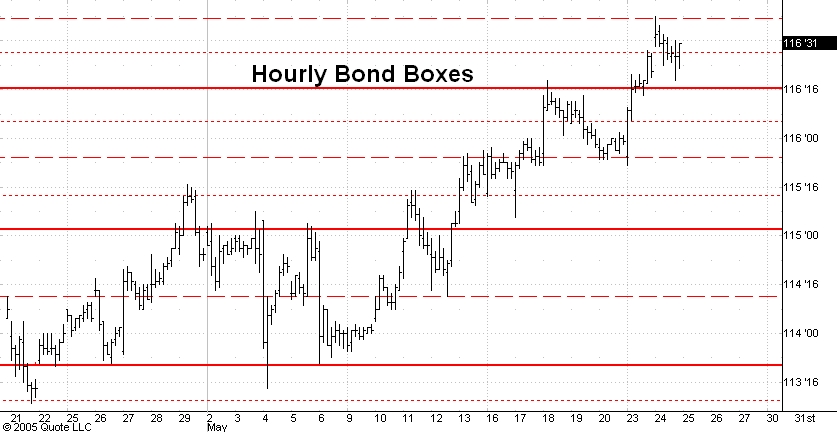
In my last post on the bonds and notes I said that both markets would probably react to the 1/2 points of the next lowest box before heading higher once more.
The bonds stopped at 117-07, the 1/2 point of the 116-16 to 117-30 box, so a drop of a full box from there would bring the market down to 115-25, the 1/2 point of the next lower box.
The notes went a bit further than we expected, stopping at 113-13, the 3/4 point of their 112-16 to 113-23 box. So a drop of a full box from there would bring the notes down to the 3/4 point of the next lower box at 112-06 which is now my target for the reaction in the notes.
As I have said often in previous posts both markets have further to go on the upside. My 2005 bond market forecast predicted a bond market top for August 2005.
The bonds stopped at 117-07, the 1/2 point of the 116-16 to 117-30 box, so a drop of a full box from there would bring the market down to 115-25, the 1/2 point of the next lower box.
The notes went a bit further than we expected, stopping at 113-13, the 3/4 point of their 112-16 to 113-23 box. So a drop of a full box from there would bring the notes down to the 3/4 point of the next lower box at 112-06 which is now my target for the reaction in the notes.
As I have said often in previous posts both markets have further to go on the upside. My 2005 bond market forecast predicted a bond market top for August 2005.
Wednesday, May 25, 2005
Is There a Real Estate Bubble?
Is there a real estate bubble in the US? Beats me! But I think it is possible to draw some conclusions from the fact that so many people are worrying about one.
First of all let's get our history straight. I know of no "bubble" that has burst while so many experts were telling people how inflated the bubble was and how the bubble was doomed to burst sooner rather than later.
But today the New York Times ran a page 1 story above the fold with the headline "Steep Rise in Prices for Homes Adds to Worry About a Bubble". A few days ago the Wall Street Journal ran a story in the "Capital" column by David Wessel with the headline "The Fed Starts to Show Concern At Signs of a Bubble in Housing". The May 30 issue of Fortune had as its cover story "Real Estate Gold Rush".
What I find so interesting about this phenomenon is that the word "bubble" nowadays has a very negative connotation, one that has resulted from the recent collapse of the dot com and telecommunication bubble stocks during 2000-2002. The word "bubble" is like the "bloody shirt" that tabloid newspapers used to wave to arouse war sentiment among the public. In my view the constant use of this term is a reflection of underlying negative attitudes, not just towards real estate but also towards financial assets. People just want to be scared. And the press satisfies popular demand by scaring its readers with the constant references to the real estate "bubble".
I draw two conclusions from this phenomenon.
First, real estate prices are not going to stop going up anytime soon. My best guess is that the (temporary) peak in real estate prices will occur just about the time the US economy starts to slip into its next recession. My 2005 stock market forecast predicts a stock market top for late this year, so I would expect the economy to peak around mid-2006.
Second, bearish attitudes towards financial assets are so prevalent that I doubt that the next bear market (in 2006) will be very severe. Probably it won't drop stock prices more than 25%. And the subsequent bull market will almost surely send the stock market averages to new all time highs by a substantial margin.
Don't let yourself be frightened by the bubble bogeyman!
First of all let's get our history straight. I know of no "bubble" that has burst while so many experts were telling people how inflated the bubble was and how the bubble was doomed to burst sooner rather than later.
But today the New York Times ran a page 1 story above the fold with the headline "Steep Rise in Prices for Homes Adds to Worry About a Bubble". A few days ago the Wall Street Journal ran a story in the "Capital" column by David Wessel with the headline "The Fed Starts to Show Concern At Signs of a Bubble in Housing". The May 30 issue of Fortune had as its cover story "Real Estate Gold Rush".
What I find so interesting about this phenomenon is that the word "bubble" nowadays has a very negative connotation, one that has resulted from the recent collapse of the dot com and telecommunication bubble stocks during 2000-2002. The word "bubble" is like the "bloody shirt" that tabloid newspapers used to wave to arouse war sentiment among the public. In my view the constant use of this term is a reflection of underlying negative attitudes, not just towards real estate but also towards financial assets. People just want to be scared. And the press satisfies popular demand by scaring its readers with the constant references to the real estate "bubble".
I draw two conclusions from this phenomenon.
First, real estate prices are not going to stop going up anytime soon. My best guess is that the (temporary) peak in real estate prices will occur just about the time the US economy starts to slip into its next recession. My 2005 stock market forecast predicts a stock market top for late this year, so I would expect the economy to peak around mid-2006.
Second, bearish attitudes towards financial assets are so prevalent that I doubt that the next bear market (in 2006) will be very severe. Probably it won't drop stock prices more than 25%. And the subsequent bull market will almost surely send the stock market averages to new all time highs by a substantial margin.
Don't let yourself be frightened by the bubble bogeyman!
Eurodollar Boxes
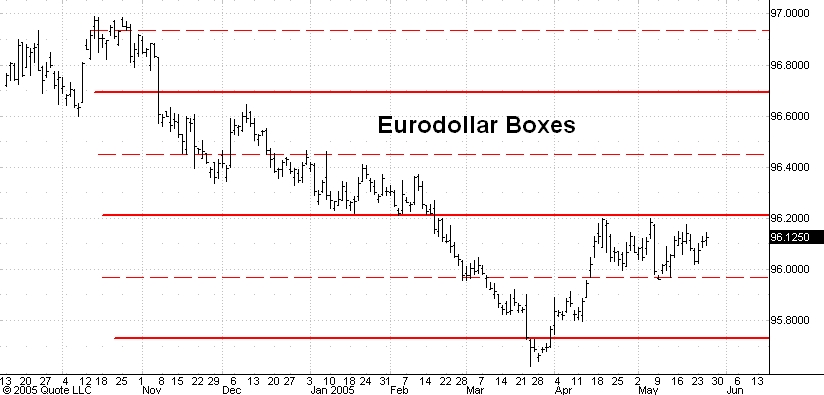
I'd like to update the box situation in the December 2005 Eurodollar futures.
The daily bar chart above shows the bear market boxes in the Eurodollar futures. They are each 48 ticks from top to bottom. I want to point out an interesting feature of these boxes which is relevant to longer term box analysis in futures contracts.
The boxes you see were originally defined in the December 2003 contract by the initial drop from the bull market top at 99.09 on June 16, 2003 to the low at 98.61 on August 1, 2003. The December 2003 contract was the active contract at the time which is why we used it to define boxes. To calculate boxes for all subsequent contracts we used this box size and position defined by this initial drop in the December 2003 contract.
The March 2005 low occurred at the 3/4 point (95.61) of the eighth box down from the 99.09 top. The subsequent rally stalled at the top of the seventh box down. But the reaction from the top of that box has held several times at the 1/2 point of the box at 95.97. I think this market will make a stab at the 1/4 point (96.33) of the sixth box down before the bear market resumes.
The daily bar chart above shows the bear market boxes in the Eurodollar futures. They are each 48 ticks from top to bottom. I want to point out an interesting feature of these boxes which is relevant to longer term box analysis in futures contracts.
The boxes you see were originally defined in the December 2003 contract by the initial drop from the bull market top at 99.09 on June 16, 2003 to the low at 98.61 on August 1, 2003. The December 2003 contract was the active contract at the time which is why we used it to define boxes. To calculate boxes for all subsequent contracts we used this box size and position defined by this initial drop in the December 2003 contract.
The March 2005 low occurred at the 3/4 point (95.61) of the eighth box down from the 99.09 top. The subsequent rally stalled at the top of the seventh box down. But the reaction from the top of that box has held several times at the 1/2 point of the box at 95.97. I think this market will make a stab at the 1/4 point (96.33) of the sixth box down before the bear market resumes.
Google on May 25
The daily chart above depicts my estimates of the boxes in Google (GOOG). Note that I have revised my estimates of their positions compared to those I made in my last post on this subject. Now I think that the box with high at 201.60 and low at 161.31 defines a box 40.29 points in height.
The 1/2 point of the third box in this sequence is 262.04. Google has been acting much better than the market and this morning the reaction from that 1/2 point has dropped GOOG to just a bit below the 1/4 point of the third box near 252. My best guess is that buyers will step in here to move the market up to the 3/4 point at 272 but if I am wrong GOOG will still be a strong buy at the bottom of the third boxe near 242.
I am very bullish on GOOG longer term and in a previous post projected a price target of 376 by the end of 2005.
The 1/2 point of the third box in this sequence is 262.04. Google has been acting much better than the market and this morning the reaction from that 1/2 point has dropped GOOG to just a bit below the 1/4 point of the third box near 252. My best guess is that buyers will step in here to move the market up to the 3/4 point at 272 but if I am wrong GOOG will still be a strong buy at the bottom of the third boxe near 242.
I am very bullish on GOOG longer term and in a previous post projected a price target of 376 by the end of 2005.
Eurocurrency Boxes
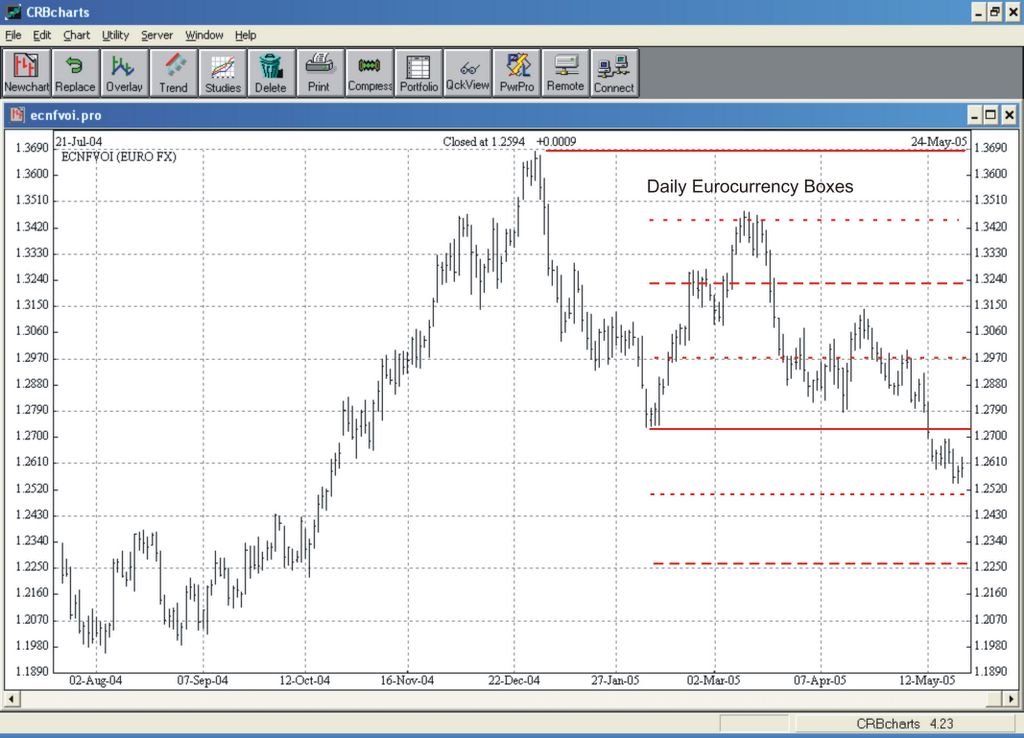
The daily chart above this post depicts the bear market boxes for the Eurocurrency futures. These boxes are 9.52 points wide and begin from the bull market top at 136.87.
The market is trading in the second box of the sequence and should drop close to the 1/2 point of this box at 122.59 before a substantial rally sets in . The next rally probably won't be as big as the first which extended a bit more than 3/4 of a box size. Instead I think that any rally that starts near the 122.59 level will carry no more than to the top of this second box which stands at 127.35.
I think this bear market in the Eurocurrency will probably carry the market below 100.
The market is trading in the second box of the sequence and should drop close to the 1/2 point of this box at 122.59 before a substantial rally sets in . The next rally probably won't be as big as the first which extended a bit more than 3/4 of a box size. Instead I think that any rally that starts near the 122.59 level will carry no more than to the top of this second box which stands at 127.35.
I think this bear market in the Eurocurrency will probably carry the market below 100.
Tuesday, May 24, 2005
S&P update
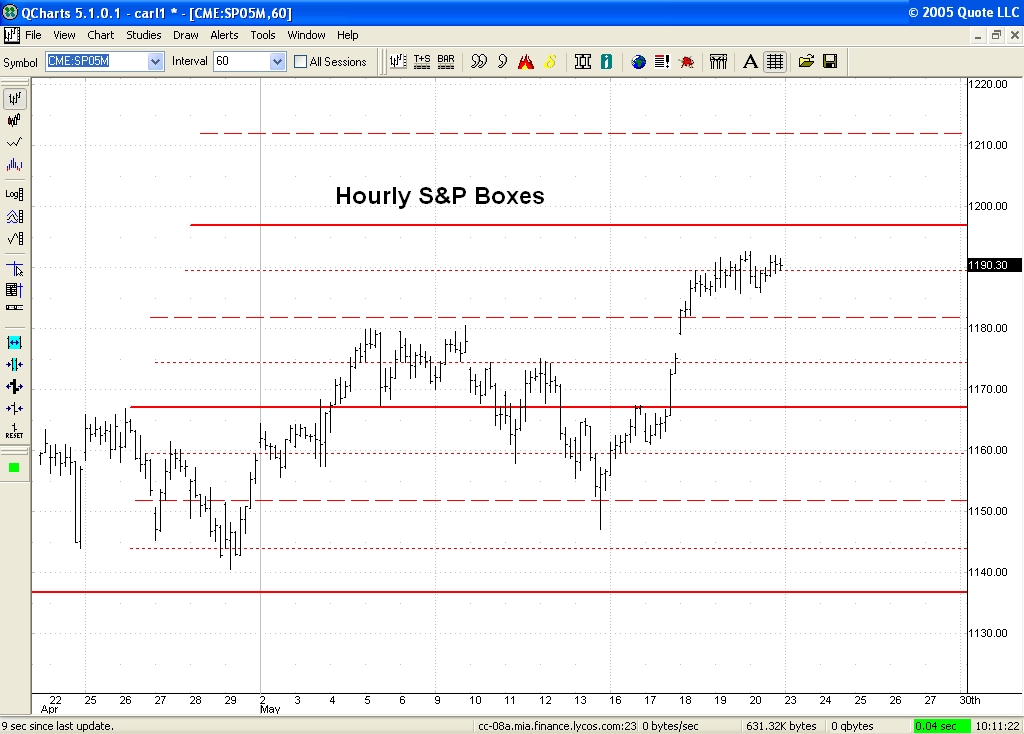
Above you will see an hourly chart showing the short term boxes in the June S&P futures. The market bounced off of the top of the second box at 1197 as expected but only made it down (so far) to the 3/4 point of the same box at 1190 instead of the 1/2 point of the box at 1182. Since I am very bullish on this market I think the big risk here is missing the upmove so I think one must presume that the market is now headed for the 1/2 point of the third box at 1212.
If my assessment is wrong and the market breaks first then I still think it is a buy near the 1/2 point of its second box at 1182.
Bonds and Notes at the close on May 24
Just a quick update to this morning's bond and note post.
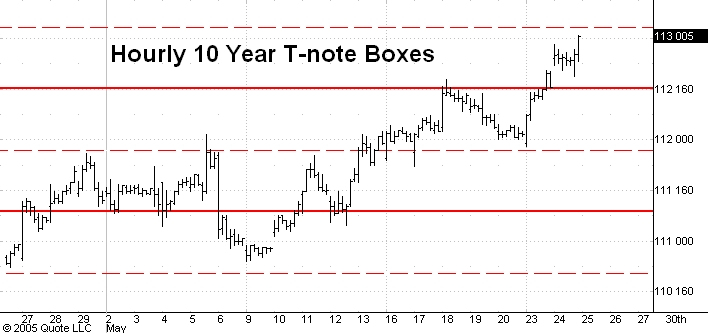
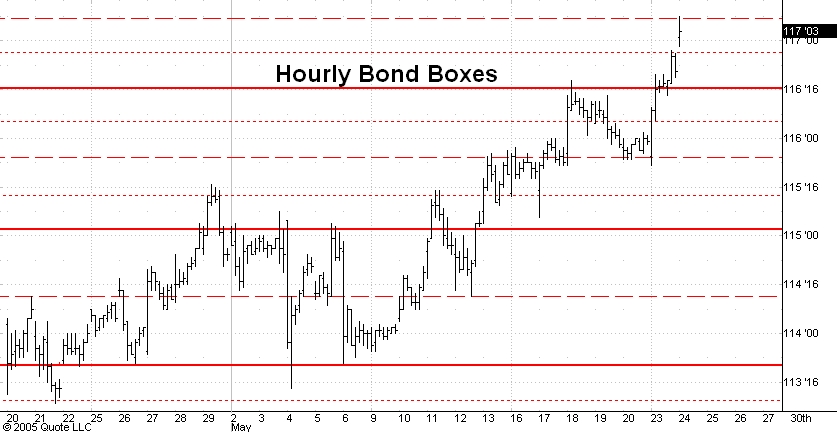
The hourly charts for the bonds and 10 year notes you see above are updated through today's close. During the day the yield curve steepened visibly (i.e. the notes went up more than in proportion to the bonds). Consequently it is now likely that we saw the top of the bonds this morning at the 1/2 point of their box at 107-07 and that the notes will also stop at the 1/2 point of their box at 113-03. My best guess is that the upcoming reaction will carry both markets down to the 1/2 point of the next lower box.
Bonds and T-notes on May 24
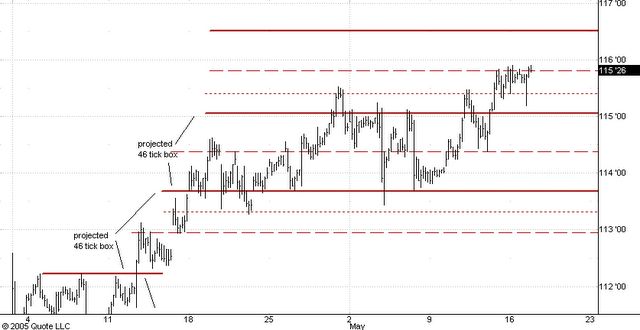
I want to update the hourly box picture for the bond and 10 year note futures.
The bonds have reached the 1/2 point at 117-07 of another 46 tick box and this suggests yet another reaction ahead. The 10 year notes have proven stronger than I had expected yesterday and are now approaching the 1/2 point of their box at 113-03. My best guess for today is that the bonds will move above their 1/2 point and break a tad above the 117-12 level, the February 9 high in the March '05 contract while the notes rally close to 113-03.
The reaction which follows will carry both markets at least to the bottom of the box they are in now and quite possibly to the 1/2 point of the next box below. I think that the uptrend which began from the late March lows in these markets is not yet complete. So this reaction will present another buying opportunity.
The bonds have reached the 1/2 point at 117-07 of another 46 tick box and this suggests yet another reaction ahead. The 10 year notes have proven stronger than I had expected yesterday and are now approaching the 1/2 point of their box at 113-03. My best guess for today is that the bonds will move above their 1/2 point and break a tad above the 117-12 level, the February 9 high in the March '05 contract while the notes rally close to 113-03.
The reaction which follows will carry both markets at least to the bottom of the box they are in now and quite possibly to the 1/2 point of the next box below. I think that the uptrend which began from the late March lows in these markets is not yet complete. So this reaction will present another buying opportunity.
Monday, May 23, 2005
10 year T-note Boxes on May 23
The hourly chart above depicts my estimate of the boxes in the June 2005 ten year note contract. The boxes were defined by the reaction on April 2 of 39 ticks from a high of 110-02 to the low of 108-27.
The market is making a second try to move into the fourth box in the uptrend but I think this attempt will fail and that we will see another reaction down to 111-28, the 1/2 point of the third box or to 111-09 the bottom of the third box.
The uptrend from the March low at 107-25 is not over yet and I think this market will probably get into the 115-116 range before the upmove ends.
The market is making a second try to move into the fourth box in the uptrend but I think this attempt will fail and that we will see another reaction down to 111-28, the 1/2 point of the third box or to 111-09 the bottom of the third box.
The uptrend from the March low at 107-25 is not over yet and I think this market will probably get into the 115-116 range before the upmove ends.
S&P Hourly Boxes
The chart above depicts my short term box analysis for the June S&P futures. In a previous post I said that the market should soon reach the top of the second box at 1197. As of Friday's close the market had rallied as far as 1192.70 and had been stalling near the 3/4 point of the box at 1190 for the better part of three days.
I am not a fortune teller so I can't say what the market's action today will be. But I do want to point out that the move up from the last low at 1147 to 1192.70 was 45.70 points, just a tad more that 1 1/2 the box size of 30 points. In my experience anytime a market moves a multiple or a multiple plus a half of the box size from an extreme and starts to stall it is likely to reverse course temporarily.
So now I think the market's next move of 10 or more points from Friday's close will be downward. A drop of half a box (15 points) from 1192.70 or from whatever high it reaches in the next couple of days would be normal. Keep in mind that the bigger trend is upward so if this break materializes it will present a buying opportunity.
I am not a fortune teller so I can't say what the market's action today will be. But I do want to point out that the move up from the last low at 1147 to 1192.70 was 45.70 points, just a tad more that 1 1/2 the box size of 30 points. In my experience anytime a market moves a multiple or a multiple plus a half of the box size from an extreme and starts to stall it is likely to reverse course temporarily.
So now I think the market's next move of 10 or more points from Friday's close will be downward. A drop of half a box (15 points) from 1192.70 or from whatever high it reaches in the next couple of days would be normal. Keep in mind that the bigger trend is upward so if this break materializes it will present a buying opportunity.
Friday, May 20, 2005
Is the Bull Market in Gold Over?
Is the bull market in gold over? At the moment my best guess is that the top near 458 last November did not mark the end of the gold bull market that started from the 252 level in August of 1999. Why? I have to admit that the explanation I am about to give illustrates that forecasting is more art than science.
The first chart above this post is a monthly bar chart of the London gold fixing over the past 30 years. There were two gold bull markets in the 1980's. One carried from 297 to 509 (71.4 %) while the other carried from 284 to 500 (76.1%). On this basis one would reasonably expect the current bull market in gold from the 252 level to stop between 432 and 444.
The second chart above this post, a weekly chart, shows that the first time the market made it into the 432-444 range in the spring of 2004 it broke $60. But that break was actually a smaller percentage break that the previous big break during the bull market. Moreover, gold then recovered to move to new bull market highs.
From this I conclude that this bull market is going to be visibly bigger that the two bull market precedents in the 1980's. The fact that the upmove from the 1999 low had lasted more than 5 years by the time the late 2004 top at 454 was established also points to the same conclusion. For this bull market has already lasted quite a bit longer than the previous four bull markets on the monthly chart, thus showing that a very long term cycle has turned upward.
My experience tells me that because gold didn't stop in the 432-444 range and has already broken above the 1996 top at 414 it will next break above the two tops of the mid-1980's bull markets at 500 and 509.
To make a more precise estimate of the likely bull market target take a look at the weekly and daily gold charts above. I have drawn in the bull market boxes for the move up from 252. These boxes are $75 high. Gold is currently reacting downward to the bottom of its third box at 402.50. From there I estimate that it will rally at least to the 1/2 point of its fourth box at 515 and possibly as high as the 3/4 point of that same box at 534.
The first chart above this post is a monthly bar chart of the London gold fixing over the past 30 years. There were two gold bull markets in the 1980's. One carried from 297 to 509 (71.4 %) while the other carried from 284 to 500 (76.1%). On this basis one would reasonably expect the current bull market in gold from the 252 level to stop between 432 and 444.
The second chart above this post, a weekly chart, shows that the first time the market made it into the 432-444 range in the spring of 2004 it broke $60. But that break was actually a smaller percentage break that the previous big break during the bull market. Moreover, gold then recovered to move to new bull market highs.
From this I conclude that this bull market is going to be visibly bigger that the two bull market precedents in the 1980's. The fact that the upmove from the 1999 low had lasted more than 5 years by the time the late 2004 top at 454 was established also points to the same conclusion. For this bull market has already lasted quite a bit longer than the previous four bull markets on the monthly chart, thus showing that a very long term cycle has turned upward.
My experience tells me that because gold didn't stop in the 432-444 range and has already broken above the 1996 top at 414 it will next break above the two tops of the mid-1980's bull markets at 500 and 509.
To make a more precise estimate of the likely bull market target take a look at the weekly and daily gold charts above. I have drawn in the bull market boxes for the move up from 252. These boxes are $75 high. Gold is currently reacting downward to the bottom of its third box at 402.50. From there I estimate that it will rally at least to the 1/2 point of its fourth box at 515 and possibly as high as the 3/4 point of that same box at 534.
How Far Will This Bull Run?
The art of forecasting lies in finding the correct historical analogy to the current market situation. I'd like to illustrate this principle by explaining how one can estimate a reasonable price target for the bull market that began from the S&P 768 level in October 2002.
The basic idea is very simple. This bull market will probably travel about as far as previous bull markets that developed in a similar situation.
The closest analogy I can find for the current bull market is the bull market in the Dow Industrials which carried that average from 570 in December 1974 to 1026 in September 1976, a move upward of 80%. The reason this is the best analogy is that the Dow had previously dropped from a high of 1067 in January 1973 to its 570 low, a move downward of 46.6%. The drop during that 1974-74 bear market was nearly as big as the 50.5% drop from 1553 to 768 during the 2000-2002 bear market. So I would expect the move up from 768 to approximate in length the move up from the 1974 low at 570. Calculating 80% of 768 we get a target of 1382 for the bull market which began from 768.
Next let's focus on some finer detail. Can we find analogies to the upmove which I believe started from the 1136 level in the S&P 500 in April 2005? My first guess is that the move up from 1136 will be approximately as long as previous upswings in the bull market that began from the 768 low. By my reckoning there were four previous upswings: from 768 to 954 (24.2%), from 788 to 1015 (28.8%), from 958 to 1063 (21.4%), and from 1060 to 1229 ( 15.9%).
The shortest of these upswings carried the market upward 15.9% and a rally that big from the 1136 level would stop at 1316. On the other hand, if we discard the smallest and the largest of these four upswings and average the remaining two we can calculate a target of 1395, not far from the 1382 target for the bull market itself. In my judgment this higher target is a more likely stopping point for the move up from 1136 because of the extreme levels of bearishness I think I see currently.
The basic idea is very simple. This bull market will probably travel about as far as previous bull markets that developed in a similar situation.
The closest analogy I can find for the current bull market is the bull market in the Dow Industrials which carried that average from 570 in December 1974 to 1026 in September 1976, a move upward of 80%. The reason this is the best analogy is that the Dow had previously dropped from a high of 1067 in January 1973 to its 570 low, a move downward of 46.6%. The drop during that 1974-74 bear market was nearly as big as the 50.5% drop from 1553 to 768 during the 2000-2002 bear market. So I would expect the move up from 768 to approximate in length the move up from the 1974 low at 570. Calculating 80% of 768 we get a target of 1382 for the bull market which began from 768.
Next let's focus on some finer detail. Can we find analogies to the upmove which I believe started from the 1136 level in the S&P 500 in April 2005? My first guess is that the move up from 1136 will be approximately as long as previous upswings in the bull market that began from the 768 low. By my reckoning there were four previous upswings: from 768 to 954 (24.2%), from 788 to 1015 (28.8%), from 958 to 1063 (21.4%), and from 1060 to 1229 ( 15.9%).
The shortest of these upswings carried the market upward 15.9% and a rally that big from the 1136 level would stop at 1316. On the other hand, if we discard the smallest and the largest of these four upswings and average the remaining two we can calculate a target of 1395, not far from the 1382 target for the bull market itself. In my judgment this higher target is a more likely stopping point for the move up from 1136 because of the extreme levels of bearishness I think I see currently.
Thursday, May 19, 2005
So You Want to be a Market Timer
Speculators who try to buy and sell so as to catch the important swings in the stock market averages are called market timers. Market timing became unpopular during the stock market boom led by the dot com and tech stocks in the 1990's. But I think market timing is making a comeback now and will become steadily more popular during the next 10 years.
Should you try to be a market timer? If you are reading this blog you probably have some interest in timing. But I don't believe most people have any idea how difficult it is to successfully time the swings in the market averages.
My argument is really a simple observation about how probabilities work. To be a successful market timer you have to make two consecutive good calls (i.e. two good calls in a row). You have to make a decision to sell and then another decision to buy so that your selling price is higher than your buying price. (I am ignoring issues which have to do with risk reduction since they only complicate my argument while not changing my conclusion.)
What are the odds that you can make two good calls in a row? Let's do a little thought experiment. Suppose the probability that you make a good call does not depend on whether your last call was a good one or not. As a baseline, suppose your are a novice market timer who makes good calls 50% of the time. What is the probability that you make two good calls in a row? It is just 50% of 50% - only 25% ! So a novice timer has only a 1 in 4 chance of making himself better off compared to a buy-and-hold strategy !
These are lousy odds and clearly someone who makes correct calls only 50% of the time shouldn't try to time the market. But suppose you are better than this. Suppose you make correct market calls 70% of the time. Well, the probability that you make two good calls in a row is then 70% of 70% or 49%. Still less than a 50 - 50 bet! Again, it makes no sense to try to time the market even if you make good calls 70% of the time!
Well, suppose you have improved your skills to the point where you make correct calls 80% of the time. I'll tell you right now that not many market timers will claim to achieve this level of skill. But even now, the probability of making two good calls in a row is 80% of 80% or 64%. This is still less than a 2 out of 3 chance!
I think my little thought experiment actually overestimates the success probability of market timing. I don't believe that the probability of making a good call is independent of whether or not your last call was good. In fact I believe that the fact that you made a good call last time makes it even more likely that your next call will be a bad one. People like to observe that the market is always changing the key to its lock, so the insight that leads you to make a good call probably won't work the next time you try it!
This explains why even famous market timers rarely have winning streaks more than 4 to 5 years in length. This is just the length of the average stock market cycle during the past 50 years.
So if you want to time the market you must recognize that the odds are stacked against you. Don't bet your retirement money on it!
Should you try to be a market timer? If you are reading this blog you probably have some interest in timing. But I don't believe most people have any idea how difficult it is to successfully time the swings in the market averages.
My argument is really a simple observation about how probabilities work. To be a successful market timer you have to make two consecutive good calls (i.e. two good calls in a row). You have to make a decision to sell and then another decision to buy so that your selling price is higher than your buying price. (I am ignoring issues which have to do with risk reduction since they only complicate my argument while not changing my conclusion.)
What are the odds that you can make two good calls in a row? Let's do a little thought experiment. Suppose the probability that you make a good call does not depend on whether your last call was a good one or not. As a baseline, suppose your are a novice market timer who makes good calls 50% of the time. What is the probability that you make two good calls in a row? It is just 50% of 50% - only 25% ! So a novice timer has only a 1 in 4 chance of making himself better off compared to a buy-and-hold strategy !
These are lousy odds and clearly someone who makes correct calls only 50% of the time shouldn't try to time the market. But suppose you are better than this. Suppose you make correct market calls 70% of the time. Well, the probability that you make two good calls in a row is then 70% of 70% or 49%. Still less than a 50 - 50 bet! Again, it makes no sense to try to time the market even if you make good calls 70% of the time!
Well, suppose you have improved your skills to the point where you make correct calls 80% of the time. I'll tell you right now that not many market timers will claim to achieve this level of skill. But even now, the probability of making two good calls in a row is 80% of 80% or 64%. This is still less than a 2 out of 3 chance!
I think my little thought experiment actually overestimates the success probability of market timing. I don't believe that the probability of making a good call is independent of whether or not your last call was good. In fact I believe that the fact that you made a good call last time makes it even more likely that your next call will be a bad one. People like to observe that the market is always changing the key to its lock, so the insight that leads you to make a good call probably won't work the next time you try it!
This explains why even famous market timers rarely have winning streaks more than 4 to 5 years in length. This is just the length of the average stock market cycle during the past 50 years.
So if you want to time the market you must recognize that the odds are stacked against you. Don't bet your retirement money on it!
Bull Market Boxes in the S&P
The weekly chart you see above depicts my estimates for the bull market boxes in the cash S&P 500 index. These boxes are 185.65 points high. The solid lines denote the positions of the top of each successive box and are found at 768.63, 954.28, 1139.93, 1325.58 and 1511.23. The dashed lines are the 1/2 points of each box.
The market has just bounced off of the top of the second box at 1139.93. The logical upside target now is the top of the third box at 1325.58. Given the level of bearishness that has built up over the past year I would not be surprised to see the market move up even more than that, perhaps to the 1/4 level of the fourth box at 1371.99 or even to the 1/2 point of that fourth box at 1418.40.
Wednesday, May 18, 2005
Markets and Imagination
Over the years I have come around to the view that a good speculator is really an artist. He or she tries to imagine events which haven't yet happened and market conditions and prices which are quite different from those which now prevail. And the speculator hopes to profit from the journey the market will make to a price which at the moment exists only in his imagination.
Like a talented painter or musician, a talented speculator cannot afford to give his imagination completely free rein. Instead his artistic conception of the future arises from a mysterious combination of intuition and technical skill.
The speculator's tools (e.g. charts, computers, market models, etc.) serve to discipline his imagination. These tools guide his insights into channels that have been carved out by historically observed correlations among events.
In the same way a painter's brush technique and use of color allows his artistic muse to express his vision in a way known to be most effective by past generations of painters.
I think that the amateur speculator's biggest problem is a lack of imagination, not a lack of tools. This problem usually shows up in his very short term outlook on markets. I belong to a number of market discussion groups and am always struck by the focus on what will happen tomorrow or next week as opposed to what the market's trend will be over the next six months or a year.
Why this extremely short term focus? Well, one reason is the ease with which people nowadays can track markets tick by tick. Only 25 years ago it was very expensive to monitor markets during trading hours so most people had to content themselves with knowing the daily high-low-close. Markets seemed then to move at a slower pace (only an illusion of course!).
But I think there is a second reason for this short term focus, a reason which reflects a fundamental misunderstanding of the way markets move. Amateur speculators seem to think that price changes are somehow more predictable over short time frames than over long time frames.
From a statistical point of view this belief is complete nonsense. In fact the volatility of price changes (measured by the standard deviation, for example) decreases as the length of time over which the price change is measured increases. Put another way, price changes are much more random in the very short run than they are in the long run!
I believe that it is much harder to forecast what the market will do today or tomorrow than it its to forecast what it will do over the next year! Moreover, even if you want to profit from short term price fluctuations, it is much easier to do this if you have a reliable estimate of what the market will be doing over a longer time frame, one which will include several of your shorter term trades.
So pick your forecasting methods so that they give you as much information as possible about the market's longer term trend. If you get this right it is much, much easier to take advantage of the short term price fluctuations which occur as the market progresses towards your more certain longer term target.
Like a talented painter or musician, a talented speculator cannot afford to give his imagination completely free rein. Instead his artistic conception of the future arises from a mysterious combination of intuition and technical skill.
The speculator's tools (e.g. charts, computers, market models, etc.) serve to discipline his imagination. These tools guide his insights into channels that have been carved out by historically observed correlations among events.
In the same way a painter's brush technique and use of color allows his artistic muse to express his vision in a way known to be most effective by past generations of painters.
I think that the amateur speculator's biggest problem is a lack of imagination, not a lack of tools. This problem usually shows up in his very short term outlook on markets. I belong to a number of market discussion groups and am always struck by the focus on what will happen tomorrow or next week as opposed to what the market's trend will be over the next six months or a year.
Why this extremely short term focus? Well, one reason is the ease with which people nowadays can track markets tick by tick. Only 25 years ago it was very expensive to monitor markets during trading hours so most people had to content themselves with knowing the daily high-low-close. Markets seemed then to move at a slower pace (only an illusion of course!).
But I think there is a second reason for this short term focus, a reason which reflects a fundamental misunderstanding of the way markets move. Amateur speculators seem to think that price changes are somehow more predictable over short time frames than over long time frames.
From a statistical point of view this belief is complete nonsense. In fact the volatility of price changes (measured by the standard deviation, for example) decreases as the length of time over which the price change is measured increases. Put another way, price changes are much more random in the very short run than they are in the long run!
I believe that it is much harder to forecast what the market will do today or tomorrow than it its to forecast what it will do over the next year! Moreover, even if you want to profit from short term price fluctuations, it is much easier to do this if you have a reliable estimate of what the market will be doing over a longer time frame, one which will include several of your shorter term trades.
So pick your forecasting methods so that they give you as much information as possible about the market's longer term trend. If you get this right it is much, much easier to take advantage of the short term price fluctuations which occur as the market progresses towards your more certain longer term target.
Short term bond boxes on May 18
The hourly chart above depicts the short term boxes in the June 2005 bond futures. These boxes are each 46 ticks wide.
Note that the market has reached my temporary short term target at the top of a box at 116-16. I still think the move up from the 109 low of late March has further to go (probably into the 118-120 range). At this juncture I would expect a reaction down to the 1/2 point of the box near 115-24 or the 1/4 point of the box near 115-10.
Google on May 18
I've been following Google's stock (GOOG) with great interest since Google went public last August. I think the progress of Google is a textbook study in the use of contrary opinion. Ive posted on this here, here and here.
The daily bar chart you see above depicts my estimates of the price boxes in GOOG. These boxes are 36.33 points high. The market is nearing the top of the second box at 237.90. From there a reaction to the 1/2 point of this second box at 219.75 would be normal. However, GOOG is acting much stronger than the market so I think a reaction from 237.90 will only be 1/4 of a box (about 9 points) instead of 1/2 a box (about 18 points). Moreover, I think a move to the 1/2 point of the second box at 256 is likely before we see any reaction of as much as 20 points in GOOG.
Short Term Dollar Outlook
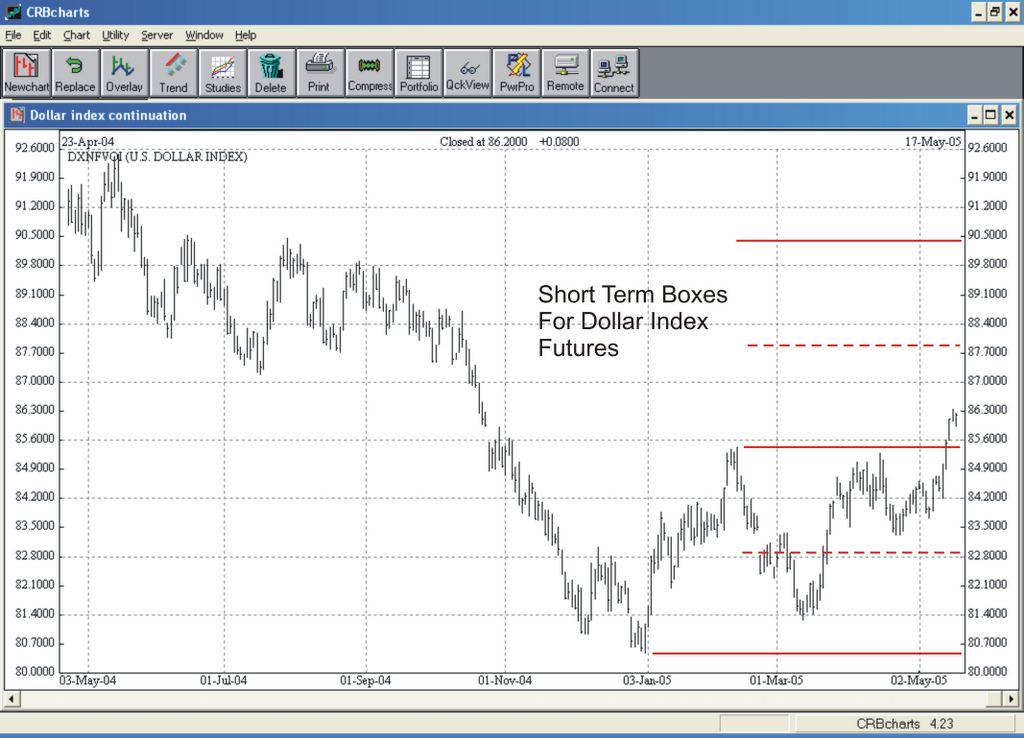
As you know I am bullish on the US dollar. The charts you see above depict my estimates of both the long term and the short term dollar boxes in a daily continuation chart of the dollar index futures.
The first thing to note in the chart of the long term dollar boxes is that the dollar bear market ended (in my opinion) at the bottom of the fourth long term box down from the 2001 high at 121.29. These boxes are 9.94 points wide and the bottom of the fourth box was 81.53 vs. an actually low of 80.48. The market is in the process of rallying back to the top of the fourth box which stands at 91.47.
On a short term basis we see that a box of 4.98 points was established on the first extended rally from the 80.48 low. The top of this first box is 85.46 while the top of the second short term box should therefore be at 90.44.
So we conclude that the next important resistance level on the way up will be in the 90.44 to 91.47 range. The market should hesitate for few days on the way to this target when it reaches the 87.95 level which is the 1/2 point of the second short term box.
After the dollar index makes it to the 90.44 to 91.47 zone we should see a normal reaction that will probably carry down to the top of the first short term box (85.46) or the 1/2 point of the fourth long term box (86.50).
The first thing to note in the chart of the long term dollar boxes is that the dollar bear market ended (in my opinion) at the bottom of the fourth long term box down from the 2001 high at 121.29. These boxes are 9.94 points wide and the bottom of the fourth box was 81.53 vs. an actually low of 80.48. The market is in the process of rallying back to the top of the fourth box which stands at 91.47.
On a short term basis we see that a box of 4.98 points was established on the first extended rally from the 80.48 low. The top of this first box is 85.46 while the top of the second short term box should therefore be at 90.44.
So we conclude that the next important resistance level on the way up will be in the 90.44 to 91.47 range. The market should hesitate for few days on the way to this target when it reaches the 87.95 level which is the 1/2 point of the second short term box.
After the dollar index makes it to the 90.44 to 91.47 zone we should see a normal reaction that will probably carry down to the top of the first short term box (85.46) or the 1/2 point of the fourth long term box (86.50).
Tuesday, May 17, 2005
A Note on T-bonds
The hourly chart you see above depicts my updated box analysis of the June T-bond futures. My last comment on this market was just after the employment number came out on May 6. I said that the bonds looked like a buy near 113-28 based on my box analysis.
The market still appears to be headed up to the top of another 46 tick box at 116-16. This morning the PPI number came out higher than the consensus estimate and housing starts were strong. Despite this bearish news the market has rallied strongly and this is good evidence that the uptrend which began late in March 2005 from the 109 level is still intact.
I think we will see t-bond futures trading in the 118-120 range within a couple of months before the rally from 109 exhausts itself. See my 2005 bond market forecast for more details.
The market still appears to be headed up to the top of another 46 tick box at 116-16. This morning the PPI number came out higher than the consensus estimate and housing starts were strong. Despite this bearish news the market has rallied strongly and this is good evidence that the uptrend which began late in March 2005 from the 109 level is still intact.
I think we will see t-bond futures trading in the 118-120 range within a couple of months before the rally from 109 exhausts itself. See my 2005 bond market forecast for more details.
Short Term S&P Outlook
The hourly bar chart above depicts my short term box analysis for the June S&P 500 futures. The market established a low at 1137 on April 20 (the overnight low of 1136 - not shown on this chart - actually occurred on April 18). I think an uptrend began there and will eventually carry the S&P to the 1350 level by the end of this year.
In any case the market seems to have established a 30 point short term box with the top of the first box at 1167 and the top of the second box at 1197. In my May 12 post on the short term S&P outlook (time and price marked by an arrow on the chart) I said that the reaction would continue to the halfway point of the first box at 1152 but would end there. In the event the market dropped briefly below 1152, closed the day above that level and has rallied since.
At this juncture it looks to me like the market is headed for the top of the second box at 1197. I think it likely that we will see reactions of only 6 to 8 points (1/4 the size of the short term box) on the way to 1197. From 1197 a bigger reaction, probably down to the halfway point of the second box around 1182, would be the normal expectation.
In any case the market seems to have established a 30 point short term box with the top of the first box at 1167 and the top of the second box at 1197. In my May 12 post on the short term S&P outlook (time and price marked by an arrow on the chart) I said that the reaction would continue to the halfway point of the first box at 1152 but would end there. In the event the market dropped briefly below 1152, closed the day above that level and has rallied since.
At this juncture it looks to me like the market is headed for the top of the second box at 1197. I think it likely that we will see reactions of only 6 to 8 points (1/4 the size of the short term box) on the way to 1197. From 1197 a bigger reaction, probably down to the halfway point of the second box around 1182, would be the normal expectation.
Monday, May 16, 2005
Three Peaks and Domed House in the Dow
For the past year I have been following the evolution of one of George Lindsay's Three Peaks and a Domed House formations in the Dow. In my 2003 and 2004 stock market forecasts I wrote that I expected such a formation to develop during the anticipated 2003-2005 bull market and in my 2005 forecast I identified such a formation in the Dow and analyzed its implications in more detail.
(Those of you who want to learn more about George Lindsay's approach to market forecasting should call Investor's Intelligence at (914) 632 - 0422 (New York state in the USA) and ask for a copy of "Selected Articles by the late George Lindsay".)
Once a Three Peaks and Domed House formation has been identified in its early stages it has great forecasting value because the market follows pretty much the same pattern time after time with minor variations. If the formation is a "major" one in Lindsay's terminology it usually lasts two years from start to finish thus giving it added forecasting value. Lindsay once estimated that the stock market in the US has historically spent about 60% of the time tracing out Three Peaks and Dome House formations.
The main characteristic of the market when a 3P-DH is developing is that the averages spend most of the time in trading ranges. Only occasionally will definite trends up or down develop and these typically last only a few weeks. This has been exactly the behavior of the Dow and S&P over the past 14 months.
The first chart you see above this post is the ideal model of a major, Three Peaks and Domed House Formation. The three peaks are labeled 3,5 and 7, while the top of the domed house is labeled 23. In a major formation peak 7 typically occurs six to ten months after peak 3. Moreover, point 23 typically occurs an average of seven months and ten days after point 14. For a more detailed discussion of the variations upon this theme one encounters check out Lindsay's original article in the booklet from Investor's Intelligence cited earlier in this post.
In my view the Dow Industrials have developed not one but two Three Peaks and Domed House formations during the past year.
The first one I discussed in my 2005 Stock Market Forecast. In that forecast I said that the three peaks were February, June and September of 2004. But since I now think this formation is only a minor formation I have relabeled the three peaks as the points 3,5 and 7 in black numerals you see in the second chart above. In this interpretation these three peaks are only separated by four months, thus making the formation a minor one. This minor formation probably ended at the April 2005 low.
There is also a major three peaks developing currently. It is labeled by the red numerals in the chart. I think that we saw point 14 on May 13. If so we can add seven months ten days to that date and estimate that point 23 will occur on December 23 of this year. I like this projection because it fits in more neatly with the implications of the other Lindsay methods which were discussed in my 2005 forecast.
So we conclude that the next seven months should be very bullish ones for the Dow.
(Those of you who want to learn more about George Lindsay's approach to market forecasting should call Investor's Intelligence at (914) 632 - 0422 (New York state in the USA) and ask for a copy of "Selected Articles by the late George Lindsay".)
Once a Three Peaks and Domed House formation has been identified in its early stages it has great forecasting value because the market follows pretty much the same pattern time after time with minor variations. If the formation is a "major" one in Lindsay's terminology it usually lasts two years from start to finish thus giving it added forecasting value. Lindsay once estimated that the stock market in the US has historically spent about 60% of the time tracing out Three Peaks and Dome House formations.
The main characteristic of the market when a 3P-DH is developing is that the averages spend most of the time in trading ranges. Only occasionally will definite trends up or down develop and these typically last only a few weeks. This has been exactly the behavior of the Dow and S&P over the past 14 months.
The first chart you see above this post is the ideal model of a major, Three Peaks and Domed House Formation. The three peaks are labeled 3,5 and 7, while the top of the domed house is labeled 23. In a major formation peak 7 typically occurs six to ten months after peak 3. Moreover, point 23 typically occurs an average of seven months and ten days after point 14. For a more detailed discussion of the variations upon this theme one encounters check out Lindsay's original article in the booklet from Investor's Intelligence cited earlier in this post.
In my view the Dow Industrials have developed not one but two Three Peaks and Domed House formations during the past year.
The first one I discussed in my 2005 Stock Market Forecast. In that forecast I said that the three peaks were February, June and September of 2004. But since I now think this formation is only a minor formation I have relabeled the three peaks as the points 3,5 and 7 in black numerals you see in the second chart above. In this interpretation these three peaks are only separated by four months, thus making the formation a minor one. This minor formation probably ended at the April 2005 low.
There is also a major three peaks developing currently. It is labeled by the red numerals in the chart. I think that we saw point 14 on May 13. If so we can add seven months ten days to that date and estimate that point 23 will occur on December 23 of this year. I like this projection because it fits in more neatly with the implications of the other Lindsay methods which were discussed in my 2005 forecast.
So we conclude that the next seven months should be very bullish ones for the Dow.
Sunday, May 15, 2005
Long Term Outlook for US Dollar
I'd like to take a look at the "big picture" for the US dollar. The chart you see above is a monthly chart of the US Dollar index. The two solid horizontal lines are drawn at the dollar index's historical high of 164.72 and its historical low of 78.19. The dashed line is the 1/2 point of this price box while the dotted lines are the 1/4 and 3/4 points.
I think an estimate of where a market stands on the overvalued- undervalued spectrum has to be the first step in making an educated guess of its likely long term trend. One has to remember that markets typically go from undervalued to overvalued and then back to undervalued, etc. Only rarely will a long term trend stop anywhere near the midpoint of the value range, i.e. at "fair value".
With this in mind look more carefully at the dollar index chart. One immediately notices that with the exception of a three year period in the mid-1980's the dollar index has traded in a range between 78 and 121. I judge this to be the value range for the dollar index. Its midpoint is the 100 level and I like to think of this midpoint as "fair value".
I conclude that since the dollar has been trading near the low end of this 78 to 121 range for all of 2005 it is definitely undervalued.
Having determined that the dollar is undervalued, I next want to check the state of public sentiment towards the dollar. See an earlier post on this subject here. There can be no question that the general expectation is that the dollar must inevitably drop from current levels, short term rallies notwithstanding.
From the facts that the dollar is undervalued and that public sentiment is bearish I conclude that its long term trend has turned upward. This means that the dollar index over the next few years should move up close to the 121 level, i.e. to the overvalued level.
Next I want to focus on details that can lead to a more precise estimate of the duration and extent of the expected upswing. Looking at the chart we see that there have been five mini-bull market in the index. Each has carried it up about 17-20 points and lasted anywhere from six months to two years. There were two major bull markets in the index. The first lasted a little more than six years and carried the index up 80 points while the second also lasted 6 years and carried the index up 40 points.
In a previous post I have already explained why Lindsay's mirror image chart for the dollar index is predicting a long term top for 2010. Putting these facts together leads to the following conclusion.
The general trend for the dollar index over the next five to six years will be upward. There should be one and more likely two mini-bull markets of 17-20 points in the index before a more extended upward trend of about 40 points and two years develops. The high of this 40 point upward trend will probably again be near the 121 level and should occur in 2010
I think an estimate of where a market stands on the overvalued- undervalued spectrum has to be the first step in making an educated guess of its likely long term trend. One has to remember that markets typically go from undervalued to overvalued and then back to undervalued, etc. Only rarely will a long term trend stop anywhere near the midpoint of the value range, i.e. at "fair value".
With this in mind look more carefully at the dollar index chart. One immediately notices that with the exception of a three year period in the mid-1980's the dollar index has traded in a range between 78 and 121. I judge this to be the value range for the dollar index. Its midpoint is the 100 level and I like to think of this midpoint as "fair value".
I conclude that since the dollar has been trading near the low end of this 78 to 121 range for all of 2005 it is definitely undervalued.
Having determined that the dollar is undervalued, I next want to check the state of public sentiment towards the dollar. See an earlier post on this subject here. There can be no question that the general expectation is that the dollar must inevitably drop from current levels, short term rallies notwithstanding.
From the facts that the dollar is undervalued and that public sentiment is bearish I conclude that its long term trend has turned upward. This means that the dollar index over the next few years should move up close to the 121 level, i.e. to the overvalued level.
Next I want to focus on details that can lead to a more precise estimate of the duration and extent of the expected upswing. Looking at the chart we see that there have been five mini-bull market in the index. Each has carried it up about 17-20 points and lasted anywhere from six months to two years. There were two major bull markets in the index. The first lasted a little more than six years and carried the index up 80 points while the second also lasted 6 years and carried the index up 40 points.
In a previous post I have already explained why Lindsay's mirror image chart for the dollar index is predicting a long term top for 2010. Putting these facts together leads to the following conclusion.
The general trend for the dollar index over the next five to six years will be upward. There should be one and more likely two mini-bull markets of 17-20 points in the index before a more extended upward trend of about 40 points and two years develops. The high of this 40 point upward trend will probably again be near the 121 level and should occur in 2010
Saturday, May 14, 2005
Index of Currency Posts
Here are posts about currency markets:
POSTS IN 2007
US Dollar - December 3
US Dollar - November 7
US Dollar Index - August 16
US Dollar and US Assets - May 22
POSTS IN 2006
The New York Times - Bearish to the Bone - December 6
The US Dollar - December 4
A Note on the Yen - November 7
Euro-USD and USD-Yen - September 28
USD \ Euro - July 27
US Dollar and the New York Times - July 18
Euro-Dollar - June 30
Dollar-Yen - June 30
Euro-USD and USD-Yen - June 29
Euro-USD - June 28
Yen and Euro - June 12
Us Dollar - June 6
US Dollar - May 22
Euro-US Dollar - May 17
Dollar Yen - May 15
Euro-USD - May 10
Dollar-Yen - April 27
Euro USD - April 27
Euro USD - April 7
US Dollar Index - April 4
US Dollar / Euro - April 3
US Dollar / Euro - March 28
US Dollar / Euro - March 23
US Dollar / Euro - March 21
US Dollar / Euro - March 16
Cash USD - euro - March 14
US Dollar/Euro - March 6
USD/Euro - February 24
Cash Euro-USD - February 10
Eurocurrency - February 8
US Dollar - January 30
US Dollar - January 26
Eurocurrency - January 23
US Dollar - January 18
Eurocurrency - January 18
US Dollar and the Eurocurrency - January 11
US Dollar Index - January 5
Eurocurrency - January 5
POSTS IN 2005
US Dollar - December 22
Eurocurrency - December 22
US Dollar - December 21
Eurocurrency - December 21
US Dollar - December 20
Eurocurrency - December 20
US Dollar Index - December 15
Eurocurrency - December 15
Eurocurrency - December 13
US Dollar - December 13
US Dollar Index - December 12
Eurocurrency - November 30
Eurocurrency - November 28
Eurocurrency - November 22
Eurocurrency - November 15
Eurocurrency - November 8
Eurocurrency - November 4
Eurocurrency - November 2
Eurocurrency - October 26
Eurocurrency - October 19
Eurocurrency - October 17
Eurocurrency - October 13
Eurocurrency - October 11
Eurocurrency - October 6
Eurocurrency - October 3
Eurocurrency - September 26
Eurocurrency - September 23
Eurocurrency - September 16
Eurocurrency - September 14
Eurocurrency - September 12
Eurocurrency - September 9
Eurocurrency - September 7
Eurocurrency - September 6
Eurocurrency - September 2
Eurocurrency - August 30
Eurocurrency - August 18
Eurocurrency Boxes - August 12
Eurocurrency Boxes - August 3
Why 125-126 - July 27
Eurocurrency - July 26
Eurocurrency - July 25
Eurocurrency - July 22
Eurocurrency - July 21
Eurocurrency - July 19
Eurocurrency - July 15
Eurocurrency - July 14
Eurocurrency - July 13
Daily Eurocurrency Boxes - July 7
Eurocurrency - July 4
Eurocurrency - July 1
Eurocurrency - June 29
Eurocurrency - June 23
Eurocurrency - June 22
Eurocurrency Boxes - June 21
Hourly Eurocurrency Boxes - June 10
Eurocurrency Update - June 6
Eurocurrency Will Rally - June 1
Eurocurrency Boxes - May 25
Long Term Dollar Boxes (chart) - May 18
Short Term Dollar Boxes (chart) - May 18
Short Term Dollar Outlook - May 18
Long Term Value for US Dollar (chart) - May 15
Long Term Outlook for US Dollar - May 15
Dollar Chart 3 - May 14
Dollar Chart 2 - May 14
Dollar Chart 1 - May 14
Mirror Images of the US Dollar - May 14
Yikes ! - April 22
The New York Times and the US Dollar - April 21
POSTS IN 2008
Dollar Bull Market Underway - August 11
POSTS IN 2007
US Dollar - December 3
US Dollar - November 7
US Dollar Index - August 16
US Dollar and US Assets - May 22
POSTS IN 2006
The New York Times - Bearish to the Bone - December 6
The US Dollar - December 4
A Note on the Yen - November 7
Euro-USD and USD-Yen - September 28
USD \ Euro - July 27
US Dollar and the New York Times - July 18
Euro-Dollar - June 30
Dollar-Yen - June 30
Euro-USD and USD-Yen - June 29
Euro-USD - June 28
Yen and Euro - June 12
Us Dollar - June 6
US Dollar - May 22
Euro-US Dollar - May 17
Dollar Yen - May 15
Euro-USD - May 10
Dollar-Yen - April 27
Euro USD - April 27
Euro USD - April 7
US Dollar Index - April 4
US Dollar / Euro - April 3
US Dollar / Euro - March 28
US Dollar / Euro - March 23
US Dollar / Euro - March 21
US Dollar / Euro - March 16
Cash USD - euro - March 14
US Dollar/Euro - March 6
USD/Euro - February 24
Cash Euro-USD - February 10
Eurocurrency - February 8
US Dollar - January 30
US Dollar - January 26
Eurocurrency - January 23
US Dollar - January 18
Eurocurrency - January 18
US Dollar and the Eurocurrency - January 11
US Dollar Index - January 5
Eurocurrency - January 5
POSTS IN 2005
US Dollar - December 22
Eurocurrency - December 22
US Dollar - December 21
Eurocurrency - December 21
US Dollar - December 20
Eurocurrency - December 20
US Dollar Index - December 15
Eurocurrency - December 15
Eurocurrency - December 13
US Dollar - December 13
US Dollar Index - December 12
Eurocurrency - November 30
Eurocurrency - November 28
Eurocurrency - November 22
Eurocurrency - November 15
Eurocurrency - November 8
Eurocurrency - November 4
Eurocurrency - November 2
Eurocurrency - October 26
Eurocurrency - October 19
Eurocurrency - October 17
Eurocurrency - October 13
Eurocurrency - October 11
Eurocurrency - October 6
Eurocurrency - October 3
Eurocurrency - September 26
Eurocurrency - September 23
Eurocurrency - September 16
Eurocurrency - September 14
Eurocurrency - September 12
Eurocurrency - September 9
Eurocurrency - September 7
Eurocurrency - September 6
Eurocurrency - September 2
Eurocurrency - August 30
Eurocurrency - August 18
Eurocurrency Boxes - August 12
Eurocurrency Boxes - August 3
Why 125-126 - July 27
Eurocurrency - July 26
Eurocurrency - July 25
Eurocurrency - July 22
Eurocurrency - July 21
Eurocurrency - July 19
Eurocurrency - July 15
Eurocurrency - July 14
Eurocurrency - July 13
Daily Eurocurrency Boxes - July 7
Eurocurrency - July 4
Eurocurrency - July 1
Eurocurrency - June 29
Eurocurrency - June 23
Eurocurrency - June 22
Eurocurrency Boxes - June 21
Hourly Eurocurrency Boxes - June 10
Eurocurrency Update - June 6
Eurocurrency Will Rally - June 1
Eurocurrency Boxes - May 25
Long Term Dollar Boxes (chart) - May 18
Short Term Dollar Boxes (chart) - May 18
Short Term Dollar Outlook - May 18
Long Term Value for US Dollar (chart) - May 15
Long Term Outlook for US Dollar - May 15
Dollar Chart 3 - May 14
Dollar Chart 2 - May 14
Dollar Chart 1 - May 14
Mirror Images of the US Dollar - May 14
Yikes ! - April 22
The New York Times and the US Dollar - April 21
Mirror Images of the US Dollar
In a recent posts (here and here) I explained some reasons why I am long term bullish on the US dollar. The three charts you see above will help me explain another reason for being bullish on the dollar.
As you probably know I am a big fan of the late George Lindsay. Lindsay said that the principal method he used to compile his extraordinary stock market forecasting record from 1953 through 1970 was the mirror image chart.
Now you have to remember that Lindsay started out as a graphic artist. His artistic sense led him to look at price charts with the eye of an artist. In particular he loved to find balance and symmetry. The common idea found in all his methods was the idea of a time symmetry around a central point. I've tried to illustrate one of his ideas, the foldback chart, in previous posts (here, here , here , and here). The idea behind a foldback chart is that price highs can be found equidistant in time from a central date, the foldback point. The same goes for lows.
The idea behind a mirror image chart is much less obvious and much more daring. As with the foldback chart, one first must identify a central date, the mirror date. Typically this is the date of a major high or low or of a test of that high or low. Then the mirror inmage chart predicts that each important price extreme after the mirror date will be the same number of days after the mirror date as an equally important extreme was before the mirror date. So far this is the same rule as in the foldback chart.
Now comes the surprise. If top occurs some number of days before the mirror date, the mirror chart predicts that a low (the mirror image of the correponding top!) will occur the same number of days after the mirror date. Similarly, a low some number of days before the mirror date predicts a top the same number of days after the mirror date.
Why should this ever work? Beats me. But one thing is for sure, once you have identified a mirror date the chart can continue making quite accurate predictions for years into the future. And remember, Lindsay himself credited his outstanding forecast record to mirror image charts.
The hard work in constructing a mirror image forecast always occurs when trying to locate a mirror date in a chart. Often I can' find any mirror date in which case I must turn to other methods. Once I have a candidate for a mirror date I check the accuracy of the first few forecasts. Typically it takes some time for the mirror forecasts to start affecting the market so it is not unusual for the first one or two forecasts to fail. But as soon as a chart's mirror forecasts start working I know I have a valuable guide to future market behavior.
The charts ( 1, 2, 3 )you see above this post are monthly charts of the US Dollar index. The April 1995 low is labeled as point X. This is the mirror date I have chosen. The extremes before the mirror date are labeled with single capital letters: A, C, E, G are lows and B, D, F are highs. The corresponding predicted mirror extremes are labeled with the same letter doubled. For example, the low at C predicts a high at CC.
The first forecast of the mirror image chart was for a high at AA in November 1997. This was wrong. But the next forecast for a low BB in January 1999 was very accurate. The high at CC and the low at DD were similarly good forecasts. The forecast high at EE was a year late. The market had already dropped 10% by that time but would drop another 27% after point EE. Finally, the mirror chart predicted an extend drop from EE to FF in June 2005. I think the June 2005 prediction will turn out to be 6 months late, but again it was within 10% of the low.
What does the mirror chart predict now? An extended bull market in the dollar! The earliest date for the predicted dollar top is point GG (not shown on the chart) in January 2010. I expect the dollar to make it back to 121 during the next five years!
As you probably know I am a big fan of the late George Lindsay. Lindsay said that the principal method he used to compile his extraordinary stock market forecasting record from 1953 through 1970 was the mirror image chart.
Now you have to remember that Lindsay started out as a graphic artist. His artistic sense led him to look at price charts with the eye of an artist. In particular he loved to find balance and symmetry. The common idea found in all his methods was the idea of a time symmetry around a central point. I've tried to illustrate one of his ideas, the foldback chart, in previous posts (here, here , here , and here). The idea behind a foldback chart is that price highs can be found equidistant in time from a central date, the foldback point. The same goes for lows.
The idea behind a mirror image chart is much less obvious and much more daring. As with the foldback chart, one first must identify a central date, the mirror date. Typically this is the date of a major high or low or of a test of that high or low. Then the mirror inmage chart predicts that each important price extreme after the mirror date will be the same number of days after the mirror date as an equally important extreme was before the mirror date. So far this is the same rule as in the foldback chart.
Now comes the surprise. If top occurs some number of days before the mirror date, the mirror chart predicts that a low (the mirror image of the correponding top!) will occur the same number of days after the mirror date. Similarly, a low some number of days before the mirror date predicts a top the same number of days after the mirror date.
Why should this ever work? Beats me. But one thing is for sure, once you have identified a mirror date the chart can continue making quite accurate predictions for years into the future. And remember, Lindsay himself credited his outstanding forecast record to mirror image charts.
The hard work in constructing a mirror image forecast always occurs when trying to locate a mirror date in a chart. Often I can' find any mirror date in which case I must turn to other methods. Once I have a candidate for a mirror date I check the accuracy of the first few forecasts. Typically it takes some time for the mirror forecasts to start affecting the market so it is not unusual for the first one or two forecasts to fail. But as soon as a chart's mirror forecasts start working I know I have a valuable guide to future market behavior.
The charts ( 1, 2, 3 )you see above this post are monthly charts of the US Dollar index. The April 1995 low is labeled as point X. This is the mirror date I have chosen. The extremes before the mirror date are labeled with single capital letters: A, C, E, G are lows and B, D, F are highs. The corresponding predicted mirror extremes are labeled with the same letter doubled. For example, the low at C predicts a high at CC.
The first forecast of the mirror image chart was for a high at AA in November 1997. This was wrong. But the next forecast for a low BB in January 1999 was very accurate. The high at CC and the low at DD were similarly good forecasts. The forecast high at EE was a year late. The market had already dropped 10% by that time but would drop another 27% after point EE. Finally, the mirror chart predicted an extend drop from EE to FF in June 2005. I think the June 2005 prediction will turn out to be 6 months late, but again it was within 10% of the low.
What does the mirror chart predict now? An extended bull market in the dollar! The earliest date for the predicted dollar top is point GG (not shown on the chart) in January 2010. I expect the dollar to make it back to 121 during the next five years!
Thursday, May 12, 2005
S&P Boxes on May 12
In my May 10 post on the S&P I said that the fact that the market had broken just below the 1167 top of the first box in an uptrend made it a buy near that level. (See black line pointing to the time and price of that post).
The market subsequently was weaker than I anticipated, dropping all the way to the 3/4 point of the first box, then rallying to the 1/4 of the second box. The fact that the market has again dropped below the top of the first box at 1167 means that it is probably headed down to the 1/2 point of the first box at 1152. I expect a rally to the top of the second box near 1197 from there.
2005 Stock Market Forecast
THE U.S. STOCK MARKET IN 2005
December 31, 2004
I have made year-ahead stock market forecasts based on George Lindsay's methods twice before, the first time on January 2, 2003 and then again on January 5, 2004. To put my 2005 forecast in perspective I first quote from the summaries of the 2003 and 2004 forecasts.
From the January 2, 2003 forecast:
"The 20 year cycle and Lindsay's 12 and 15 year periods all suggest that a bear market low occurred in 2002 and that a bull market top is due possibly as early as late 2004 but more likely sometime in 2005.
"The drop from the market's December 2002 top will probably end at a low above the October 2002 low and terminate the basic decline which began from the march 18, 2002 top. Counting forward a long basic advance of 26 to 32 months from the upcoming secondary low also projects a bull market top for 2005. Finally, I suspect that the first stage of this bull market will take the form of Lindsay's three peaks and a domed house formation."
From the March 21, 2003 update to this forecast:
" [the] low established on March 12 [2003] ended the drop from the 954 top [of December 2002]. Counting forward 26 to 32 months (a long or extended basic advance) from March 12 we find a bull market high likely sometime between May and November 2005...If this foldback pattern continues to develop the market should now rally to the level of the top of the big rally which preceeded the drop into the July, 2002 low. This is the 1178 level. After 1178 is reached [in late 2003 or in 2004] the foldback pattern would then call for a drop to the 940 level (2004?) and then a rally to 1320 (mid 2005)."
From the January 5, 2004 forecast:
"These calculations all point to the same general conclusion. The first half of 2004 should be bullish although not as strong as the last 9 months of 2003. A good part of the year's first 9 months will probably be spent in an 80 point trading range [in the S&P]. A top should develop around 1178 and be followed by a substantial break of 120-180 S&P points and this break will probably end in the fall of 2004. After that low a fast advance lasting 7 to 8 months should culminate at the peak of the domed house and a bull market top around 1340 in 2005."
What can Lindsay's methods tell us about 2005?
First let's consider the 20 year cycle and Lindsay's long term time periods. The years 1985, 1965, 1945, 1925 and 1905 were all bullish years for U.S. stocks. Lindsay's 15 year 3 month period from bear market lows to bull market highs reinforces this 20 year cycle, bullish prognosis. Adding 15 years 3 months to the October 1990 low predicts a bull market top for January 31, 2006. Moreover, adding 12 years 10 months (Lindsay's time period from bull market tops to bear market lows) to the January 31, 1994 top (which started a year long sideway's period) predicts a bear market low for December 1, 2006. The predicted 10 month interval from 2006 high to 2006 low is the length of one of Lindsay's basic declines. This internal consistency reinforces our confidence in the forecast of a bullish 2005.
The next step in Lindsay's forecast technique is to consider the status of the market in terms of his theory of basic advances. These are time intervals, measured in calendar days, which typically start at bear market lows or at secondary lows near the bear market low and end at or very near the subsequent bull market top. In my 2003 and 2004 forecasts I noted that the 1998-2000 basic advance was abnormally short. Lindsay's theory of alternation would therefore lead me to expect an abnormally long basic advance for the 2002- 2005 bull market. After analyzing the basic declines during the 2000-2002 bear market I concluded that the March 12, 2003 secondary low probably marked the start of a long or extended basic advance. This in turn implies that a bull market top should probably develop sometime between May and November of 2005.
The fact that Lindsay's theory of basic advances predicts a bull market top before his long term time periods do also has some implications. Lindsay often observed that when these two forecast methods are out of sync by a few months the market does its best to make both "come true" for all practical purposes. In this instance I would therefore expect either a top very near the average forecast date (i.e. around September- October 2005) or alternately (see below) a top in July followed by a sideways trading range that terminate in January 2006. In either case 2006 should be a bearish year.
At this juncture we also have two additional pieces of information that were not available a year ago.
In the previous two annual forecasts I said that I expected a Lindsay "three peaks and a domed house" formation to develop during the 2002-2005 bull market. Just such a pattern developed in the Dow Industrials during 2004. The three peaks came in February, June and September and spanned a 7 month interval. This compares favorably with the 6 to 10 month interval Lindsay observed for major examples of this 3P-DH pattern. The subsequent separating decline in the Dow ended on October 25 at 9708. I interpret the December 9 low as Lindsay's base point for measuring forward in time. To this date we add 7 months 10 days to predict July 19, 2005 for the top of the domed house rally and the end of the bull market. Lindsay also observed that after the domed house is completed the subsequent bear market returns at least to the price level at which the three peaks formation began. This in my interpretation is the 958 low of August 2003. Thus 958 is a reasonable target for the bear market low expected late in 2006.
The second piece of information is the development during 2004 of what Lindsay called the "middle section" of the basic advance. In this case it is a declining middle section and lasted from February to October in the Dow and from March to August in the S&P. I shall use the Dow to make my projections to maintain consistency with the 3P-DH analysis above.
Lindsay's "count from the middle section" is a long term tool and in principle can be used only to predict the timing of the next bear market low and of the subsequent bull market high. However, Lindsay himself often described the process of forecasting as similar to the process of assembling a jig-saw puzzle. All of the pieces (forecasts derived from various techniques: long term time periods, basic advances and declines, 3P-DH and counts from the middle section) have to fit together smoothly. This requirement makes the entire Lindsay method much more effective than any one of its techniques used in isolation.
In this instance we know that Lindsay's other methods predict a bull market top for the second half of 2005 and a bear market low late in 2006. Moreover, counting 15 years three months from the March 1994 low brings us to June 2009 as a likely bull market top. Now we can attempt to count from 2004's middle section in the Dow. Lindsay's "point E" for this decending middle section is June 25, 2004 in our interpretation. The first consideration is that the time from this point E to the bull market top should equal the time from the bull market top to the next bear market low. At the moment my best estimate for this low comes from the 12 year 10 month time interval and is December 1, 2006. This is a little more than 29 months from point E and if the count from the middle section were to work exactly this would imply a bull market top 14 쩍 months after June 25, 2004, i.e. September 10, 2005.
Moroever, the duration of the subsequent bull market, in Lindsay's theory of the middle section, should equal the time from point E to the bear market low. My current estimate for this time interval (again based on the 12 year 10 month period) is 29 months and thus I would expect a bull market top in May 2009, almost exactly coincident with the implication of the 15 year 3 month period from low to high.
Let's now summarize the deductions I have drawn from Lindsay's timing methods. First, 2005 should be a generally bullish year. The bull market top could come as early as July 19, 2005 (3P-DH) or as late as January 31, 2006 (15 year 3 month period). My best guess is that in any case the market will trade essentially sideways after July 19, 2005 but that no really bad drop will occur until 2006 begins.
A bear market should be expected for 2006 with a low coming late in the year. The years 2007 and 2008 are expected to be bullish with a bull market top in 2009.
Where might the S&P stand at these highs and lows? Here Lindsay's timing methods are silent but I can make some deductions based on historical averages.
The 2000-2002 bear market dropped the S&P 50%. The last bear market of comparable magnitude was the 1973-1974 bear market. The subsequent 1974-1976 bull market sent prices up 77%. A comparable advance from the 2002 low of 768 predicts a 2005 top at 1350. The 1976-78 bear market dropped prices 28%. A similar drop from a 2005 top at 1350 would give a low in 2006 around 980. This should be compared with the 958 forecast for that low derived from the 3P-DH formation. The 1978-1980 bull market moved the S&P up to 225% of its 1974 low. A repeat performance for the 2007-2009 bull market would predict a top for the S&P in 2009 at 1730.
For those interested in learning more about Lindsay's methods we suggest the booklet "Selected Articles by the late George Lindsay" which is published by Investors Intelligence in New Rochelle, New York.
Carl Futia
Copyright 2004.
December 31, 2004
I have made year-ahead stock market forecasts based on George Lindsay's methods twice before, the first time on January 2, 2003 and then again on January 5, 2004. To put my 2005 forecast in perspective I first quote from the summaries of the 2003 and 2004 forecasts.
From the January 2, 2003 forecast:
"The 20 year cycle and Lindsay's 12 and 15 year periods all suggest that a bear market low occurred in 2002 and that a bull market top is due possibly as early as late 2004 but more likely sometime in 2005.
"The drop from the market's December 2002 top will probably end at a low above the October 2002 low and terminate the basic decline which began from the march 18, 2002 top. Counting forward a long basic advance of 26 to 32 months from the upcoming secondary low also projects a bull market top for 2005. Finally, I suspect that the first stage of this bull market will take the form of Lindsay's three peaks and a domed house formation."
From the March 21, 2003 update to this forecast:
" [the] low established on March 12 [2003] ended the drop from the 954 top [of December 2002]. Counting forward 26 to 32 months (a long or extended basic advance) from March 12 we find a bull market high likely sometime between May and November 2005...If this foldback pattern continues to develop the market should now rally to the level of the top of the big rally which preceeded the drop into the July, 2002 low. This is the 1178 level. After 1178 is reached [in late 2003 or in 2004] the foldback pattern would then call for a drop to the 940 level (2004?) and then a rally to 1320 (mid 2005)."
From the January 5, 2004 forecast:
"These calculations all point to the same general conclusion. The first half of 2004 should be bullish although not as strong as the last 9 months of 2003. A good part of the year's first 9 months will probably be spent in an 80 point trading range [in the S&P]. A top should develop around 1178 and be followed by a substantial break of 120-180 S&P points and this break will probably end in the fall of 2004. After that low a fast advance lasting 7 to 8 months should culminate at the peak of the domed house and a bull market top around 1340 in 2005."
What can Lindsay's methods tell us about 2005?
First let's consider the 20 year cycle and Lindsay's long term time periods. The years 1985, 1965, 1945, 1925 and 1905 were all bullish years for U.S. stocks. Lindsay's 15 year 3 month period from bear market lows to bull market highs reinforces this 20 year cycle, bullish prognosis. Adding 15 years 3 months to the October 1990 low predicts a bull market top for January 31, 2006. Moreover, adding 12 years 10 months (Lindsay's time period from bull market tops to bear market lows) to the January 31, 1994 top (which started a year long sideway's period) predicts a bear market low for December 1, 2006. The predicted 10 month interval from 2006 high to 2006 low is the length of one of Lindsay's basic declines. This internal consistency reinforces our confidence in the forecast of a bullish 2005.
The next step in Lindsay's forecast technique is to consider the status of the market in terms of his theory of basic advances. These are time intervals, measured in calendar days, which typically start at bear market lows or at secondary lows near the bear market low and end at or very near the subsequent bull market top. In my 2003 and 2004 forecasts I noted that the 1998-2000 basic advance was abnormally short. Lindsay's theory of alternation would therefore lead me to expect an abnormally long basic advance for the 2002- 2005 bull market. After analyzing the basic declines during the 2000-2002 bear market I concluded that the March 12, 2003 secondary low probably marked the start of a long or extended basic advance. This in turn implies that a bull market top should probably develop sometime between May and November of 2005.
The fact that Lindsay's theory of basic advances predicts a bull market top before his long term time periods do also has some implications. Lindsay often observed that when these two forecast methods are out of sync by a few months the market does its best to make both "come true" for all practical purposes. In this instance I would therefore expect either a top very near the average forecast date (i.e. around September- October 2005) or alternately (see below) a top in July followed by a sideways trading range that terminate in January 2006. In either case 2006 should be a bearish year.
At this juncture we also have two additional pieces of information that were not available a year ago.
In the previous two annual forecasts I said that I expected a Lindsay "three peaks and a domed house" formation to develop during the 2002-2005 bull market. Just such a pattern developed in the Dow Industrials during 2004. The three peaks came in February, June and September and spanned a 7 month interval. This compares favorably with the 6 to 10 month interval Lindsay observed for major examples of this 3P-DH pattern. The subsequent separating decline in the Dow ended on October 25 at 9708. I interpret the December 9 low as Lindsay's base point for measuring forward in time. To this date we add 7 months 10 days to predict July 19, 2005 for the top of the domed house rally and the end of the bull market. Lindsay also observed that after the domed house is completed the subsequent bear market returns at least to the price level at which the three peaks formation began. This in my interpretation is the 958 low of August 2003. Thus 958 is a reasonable target for the bear market low expected late in 2006.
The second piece of information is the development during 2004 of what Lindsay called the "middle section" of the basic advance. In this case it is a declining middle section and lasted from February to October in the Dow and from March to August in the S&P. I shall use the Dow to make my projections to maintain consistency with the 3P-DH analysis above.
Lindsay's "count from the middle section" is a long term tool and in principle can be used only to predict the timing of the next bear market low and of the subsequent bull market high. However, Lindsay himself often described the process of forecasting as similar to the process of assembling a jig-saw puzzle. All of the pieces (forecasts derived from various techniques: long term time periods, basic advances and declines, 3P-DH and counts from the middle section) have to fit together smoothly. This requirement makes the entire Lindsay method much more effective than any one of its techniques used in isolation.
In this instance we know that Lindsay's other methods predict a bull market top for the second half of 2005 and a bear market low late in 2006. Moreover, counting 15 years three months from the March 1994 low brings us to June 2009 as a likely bull market top. Now we can attempt to count from 2004's middle section in the Dow. Lindsay's "point E" for this decending middle section is June 25, 2004 in our interpretation. The first consideration is that the time from this point E to the bull market top should equal the time from the bull market top to the next bear market low. At the moment my best estimate for this low comes from the 12 year 10 month time interval and is December 1, 2006. This is a little more than 29 months from point E and if the count from the middle section were to work exactly this would imply a bull market top 14 쩍 months after June 25, 2004, i.e. September 10, 2005.
Moroever, the duration of the subsequent bull market, in Lindsay's theory of the middle section, should equal the time from point E to the bear market low. My current estimate for this time interval (again based on the 12 year 10 month period) is 29 months and thus I would expect a bull market top in May 2009, almost exactly coincident with the implication of the 15 year 3 month period from low to high.
Let's now summarize the deductions I have drawn from Lindsay's timing methods. First, 2005 should be a generally bullish year. The bull market top could come as early as July 19, 2005 (3P-DH) or as late as January 31, 2006 (15 year 3 month period). My best guess is that in any case the market will trade essentially sideways after July 19, 2005 but that no really bad drop will occur until 2006 begins.
A bear market should be expected for 2006 with a low coming late in the year. The years 2007 and 2008 are expected to be bullish with a bull market top in 2009.
Where might the S&P stand at these highs and lows? Here Lindsay's timing methods are silent but I can make some deductions based on historical averages.
The 2000-2002 bear market dropped the S&P 50%. The last bear market of comparable magnitude was the 1973-1974 bear market. The subsequent 1974-1976 bull market sent prices up 77%. A comparable advance from the 2002 low of 768 predicts a 2005 top at 1350. The 1976-78 bear market dropped prices 28%. A similar drop from a 2005 top at 1350 would give a low in 2006 around 980. This should be compared with the 958 forecast for that low derived from the 3P-DH formation. The 1978-1980 bull market moved the S&P up to 225% of its 1974 low. A repeat performance for the 2007-2009 bull market would predict a top for the S&P in 2009 at 1730.
For those interested in learning more about Lindsay's methods we suggest the booklet "Selected Articles by the late George Lindsay" which is published by Investors Intelligence in New Rochelle, New York.
Carl Futia
Copyright 2004.
2004 Stock Market Forecast
THE U.S STOCK MARKET IN 2004
January 2, 2004
Our last long term stock market forecast was published on January 2, 2003 and updated on March 21, 2003. The January forecast predicted that the October 2002 low at 768 would prove to be the lowest level the S&P would reach until at least the end of 2005. Moreover, we asserted that the market drop which had begun in the S&P 500 from 953 on December 2, 2002 would end at a low above the 768 low and that this higher low would occur some time in the January- February time frame.
On March 21 we identified the March 12 low at 788 as the low of that decline and predicted that the advance that had just begun would carry the S&P to 1178 before a reaction of 10% or more would occur. This price target was based upon what we thought was a likely symmetry or fold-back pattern in the S&P. If this pattern were to continue it would imply a rally to the March 2002 top at 1178, a subsequent drop to the September 2001 low at 944 and then a rally above the 1300 level.
So far the stock market appears to be following this script pretty well and until a big deviation becomes obvious there is little reason to alter our general expectation. Our best guess is that the S&P will trade in the 1000-1200 range during 2004. Moreover, the first half of the year should continue the bullish tendency of 2003 while the second half of 2004 should see a drop in this average of 10-15%.
This estimate of the S&P's likely pattern in 2004 is based in part on our interpretation of George Lindsay's stock market prediction methods. In our January 2003 forecast we explained why these methods pointed to an ongoing bull market which would continue well into 2005.
The general timing of the expected bull market top in 2005 was suggested by Lindsay's long time period of 15 years 3 months from low to high which predicts a top in January 2006 if started from the October 1990 low. Lindsay's 28 year time period from high to high would suggest a top in September 2004 if started from the September 1976 top. The 20, 40 and 60 year cycles all suggest that 2004 and 2005 will be bullish years on average while the average of these cycles predicts a big break in 2006. Moreover, this general picture is consistent with the 4 year cycle in stock prices which has been very dominant since 1950 and last bottomed in 2002.
The Mach 12, 2003 low ended one of Lindsay's basic declines, as did the September 21, 2001 low. In each of these cases the preceeding basic advance had been subnormal in duration and when this happens Lindsay's rule is to expect the subsequent basic advance to last anywhere from 26 to 32 months. The September 21, 2001 low thus leads us to expect some sort of visible top in the November 2003 to May 2004 time frame. The fold-back pattern predicts this high around 1178. However, this is too early for the bull market top and so we would expect only a drop to 10-15% in the averages before a move to new highs for the move up from 768 begins.
The basic advance from the March 2003 low is projected to end in the May 2005 to November 2005 time frame. This is likely to be the bull market top and should occur somewhere above 1300 based upon the fold back pattern. We might add that Lindsay put significant weight on the Jupiter-Saturn synodic cycle of about 20 years. This cycle called for a big top in May 2000 and another top in December 2005.
Lindsay observed that the U.S. stock market tended to follow what he called a "Three Peaks and a Domed House" formation roughly 60 % of the time from the mid-1800's until the present. This pattern typically lasts about 20 months from the date of the first peak until the top of the domed house which usually ends a bull market. The three peaks typically occur at about the same level (although there are substantial variations here) and mark the end of the first advancing phase of the bull market. About 7 to 9 months typically separates the the first peak from the third. Our guess is that a three peaks pattern has already started to develop (in which case the first peak occurred on September 19, 2003 at 1039) or will soon do so. This would suggest that no significant break will start until at least 7 months has elapsed from the first peak. Thus April 2004 is the earliest we would expect the market to be vulnerable to a drop of 10% or more. It is interesting to compare this with the basic advance fromm the September 2001 low which projects some sort of top in the November 2003-May 2004 time frame.
If a three peaks-domed house indeed started in September 2003 then the peak of the domed house and the end of the bull market becomes likely about 20 months later, i.e. in May 2005.
These calculations all point to the same general conclusion. The first half of 2004 should be bullish although not as strong as the last 9 months of 2003. A good part of the year's first 9 months will probably be spent in an 80 point trading range. A top should develop around 1178 and be followed by a substantial break of 120-180 S&P points and this break will probably end in the fall of 2004. After that low a fast advance lasting 7 to 8 months should culminate at the peak of the domed house and a bull market top around 1340 in 2005.
Carl Futia
Copyright 2004
January 2, 2004
Our last long term stock market forecast was published on January 2, 2003 and updated on March 21, 2003. The January forecast predicted that the October 2002 low at 768 would prove to be the lowest level the S&P would reach until at least the end of 2005. Moreover, we asserted that the market drop which had begun in the S&P 500 from 953 on December 2, 2002 would end at a low above the 768 low and that this higher low would occur some time in the January- February time frame.
On March 21 we identified the March 12 low at 788 as the low of that decline and predicted that the advance that had just begun would carry the S&P to 1178 before a reaction of 10% or more would occur. This price target was based upon what we thought was a likely symmetry or fold-back pattern in the S&P. If this pattern were to continue it would imply a rally to the March 2002 top at 1178, a subsequent drop to the September 2001 low at 944 and then a rally above the 1300 level.
So far the stock market appears to be following this script pretty well and until a big deviation becomes obvious there is little reason to alter our general expectation. Our best guess is that the S&P will trade in the 1000-1200 range during 2004. Moreover, the first half of the year should continue the bullish tendency of 2003 while the second half of 2004 should see a drop in this average of 10-15%.
This estimate of the S&P's likely pattern in 2004 is based in part on our interpretation of George Lindsay's stock market prediction methods. In our January 2003 forecast we explained why these methods pointed to an ongoing bull market which would continue well into 2005.
The general timing of the expected bull market top in 2005 was suggested by Lindsay's long time period of 15 years 3 months from low to high which predicts a top in January 2006 if started from the October 1990 low. Lindsay's 28 year time period from high to high would suggest a top in September 2004 if started from the September 1976 top. The 20, 40 and 60 year cycles all suggest that 2004 and 2005 will be bullish years on average while the average of these cycles predicts a big break in 2006. Moreover, this general picture is consistent with the 4 year cycle in stock prices which has been very dominant since 1950 and last bottomed in 2002.
The Mach 12, 2003 low ended one of Lindsay's basic declines, as did the September 21, 2001 low. In each of these cases the preceeding basic advance had been subnormal in duration and when this happens Lindsay's rule is to expect the subsequent basic advance to last anywhere from 26 to 32 months. The September 21, 2001 low thus leads us to expect some sort of visible top in the November 2003 to May 2004 time frame. The fold-back pattern predicts this high around 1178. However, this is too early for the bull market top and so we would expect only a drop to 10-15% in the averages before a move to new highs for the move up from 768 begins.
The basic advance from the March 2003 low is projected to end in the May 2005 to November 2005 time frame. This is likely to be the bull market top and should occur somewhere above 1300 based upon the fold back pattern. We might add that Lindsay put significant weight on the Jupiter-Saturn synodic cycle of about 20 years. This cycle called for a big top in May 2000 and another top in December 2005.
Lindsay observed that the U.S. stock market tended to follow what he called a "Three Peaks and a Domed House" formation roughly 60 % of the time from the mid-1800's until the present. This pattern typically lasts about 20 months from the date of the first peak until the top of the domed house which usually ends a bull market. The three peaks typically occur at about the same level (although there are substantial variations here) and mark the end of the first advancing phase of the bull market. About 7 to 9 months typically separates the the first peak from the third. Our guess is that a three peaks pattern has already started to develop (in which case the first peak occurred on September 19, 2003 at 1039) or will soon do so. This would suggest that no significant break will start until at least 7 months has elapsed from the first peak. Thus April 2004 is the earliest we would expect the market to be vulnerable to a drop of 10% or more. It is interesting to compare this with the basic advance fromm the September 2001 low which projects some sort of top in the November 2003-May 2004 time frame.
If a three peaks-domed house indeed started in September 2003 then the peak of the domed house and the end of the bull market becomes likely about 20 months later, i.e. in May 2005.
These calculations all point to the same general conclusion. The first half of 2004 should be bullish although not as strong as the last 9 months of 2003. A good part of the year's first 9 months will probably be spent in an 80 point trading range. A top should develop around 1178 and be followed by a substantial break of 120-180 S&P points and this break will probably end in the fall of 2004. After that low a fast advance lasting 7 to 8 months should culminate at the peak of the domed house and a bull market top around 1340 in 2005.
Carl Futia
Copyright 2004
2003 Stock Market Forecast
January 2, 2003
The analytical methods of the late George Lindsay often offer unique insights into the probable course of the stock market averages in the U.S. The advent of this new year offers a particularly interesting juncture at which I believe they have something very important to say.
Anyone with an interest in learning about George Lindsay's stock market methods would do well to obtain a copy of a booklet entitled "Selected Articles by the late George Lindsay". It is available for a modest price from Investor???s Intelligence in New Rochelle, NY (Tel: 914 632 0422 ) (usinfo@investorsintelligence.com).
The methods used in the analysis below are those which Lindsay referred to as his long time intervals of 15 and 12 years and the method of basic advances and declines. Both of these are described in his article "Counts from the Middle Section" in the booklet cited above. Additional details on these methods can also be found in the article "Interpreting the Stock Market Day-by Day" in the same booklet.
I shall not have much to say about Lindsay's other two, long term forcasting techniques: the three peaks and domed house formation and the method of counts from the middle section. At the current time neither one has much to say about the current market situation, but both can be very valuable in the appropriate context.
THE 20 YEAR CYCLE
In my last conversation with Lindsay back in 1981 he told me that his forecasts were based 95% on his methods for counting time. Lindsay regarded the 20 year cycle in stock prices a very important one.
In August of 1982 the US stock market established an important low and the great stock market boom of the next 18 years began. Counting forward 20 years we arrive at August 2002, suggesting that a major low was due then. The year 1983 was a generally bullish year for stocks and so the 20 year cycle suggests that 2003 will be bullish also.
In June and October 1962 the Dow established important lows from which a 3 -year bull market began. Thus the 40 year cycle suggest a low in 2002 and a bullish year in 2003.
Finally, the Dow ended a 5 year bear market in April 1942 and then began a 4 year bull market. Counting forward 60 years one would expect a low in 2002 with a new bull market beginning from that low.
LINDSAY'S LONG TIME PERIODS
The cornerstone of Lindsay's long term forecasts were his long time periods of 15 and 12 years.
Lindsay had observed that counting forward an average of 12 years and 6 months from important bull market tops often comes very close in time to a bear market low or to an important secondary low close to the level of the bear market low.
Lindsay also observed that couning forward an average of 15 years and 6 months from a bear market low often comes very close in time to a bull market top or to a secondary top at nearly the same price level as the bull market top.
Lindsay placed special emphasis on those situations in which one can start counting a 12 year period from the end of a 15 year period "that worked" and vice versa. In other words, he believed that there was a 28 year period from high to high and low to low.
There was a very important bear market low in October 1974 (S&P 500) and December 1974 (Dow). Couning forward 15 years and 6 months we arrive at March-May 1990. A bull market top occurred in July, 1990 and was followed by a brief bear market that dropped the averages 20% and heralded the 1990-1991 recession. Counting forward 12 years and 6 months from the July 1990 we arrive at January 2003 as a time for a bear market low. Counting forward 28 years from the 1974 low we arrive at the Ocober-December 2002 period as the ideal time for such a low.
Linday's long time periods clearly forecast a bear market low late in 2002 or early in 2003.
Do these long periods tell us anything about the timing of the next bull market top? Counting forward 15 years and 6 months from the October 1990 low we arrive at April 2006 as at projected bull market top. On the other hand, from the bull market top in September 1976 we can count forward 28 years and find September 2004 as a date for the next bull market top. The former projection agrees better with the 20 year cycle and planetary periods discussed above. The latter projection agrees better with the mechanical 4 year cycle projection. However, the best way to resolve a conflict such as this is to check these projections against the implications of Lindsay's method of basic advances and declines.
BASIC ADVANCES AND DECLINES
Lindsay observed that there was a remarkable consistency in the time, measured in calenday days, that it took bull and bear trends in the averages to move from high to low or low to high. His theory of these so-called basic advances and declines is explained in the articles cited above.
The 2000-2002 bear market was unusual in that it consisted of two basic declines, back to back. The typical basic decline lasts anywhere from 8 to 15 months (Lindsay classifies them into three types: subnormal - about 8 months, normal- about 11 months, and long about 14 months). Lindsay's rule was that once a basic decline ended a basic advance had to begin. In a situation like the 2000-2002 bear market, the market will make a lower low during the course of the basic advance which begins after the bear market's first basic decline has ended.
The first basic decline of the 2000- 2002 bear market began on September 1, 2000 and ended on September 21, 2001, lasting 385 days. Lindsay would have begun this decline from the lower top in September 2000 instead of the bull market top in January or March of that year because the market's action for the first 8 months of 2000 was an extended sideways period ending at what Lindsay calls a "right shoulder". The right shoulder is the preferred starting point for counting a basic decline.
The 385 day length of the first basic decline classifies it as a "long" basic decline. A basic advance started on September 21, 2001. Since the basic advance which ended the 1998-2000 bull market was of subnormal length in Lindsay's classification, the subsequent basic advance should be expected to be long (about 26 months) or extended (about 32 months). In this case a 26 month basic advance would end in November 2003, coincident with minor synodic cycles cited above. This suggests that the late 2003 turing point will be an intermediate term high point.
At this point we can entertain an interesting hypothesis. According to Lindsay, the stock market can usually be found in some stage of a 3 peaks and a domed house formation about 60% of the time. We speculate that the first stage of the upcoming bull market will take the form of the three peaks. If the first peak occurred on December 2, 2002, the third peak can be expected about 9-10 months later, in this case September-October 2003. From the third peak an intermediate term (10-15%) decline can be expected and from the subsequent low another strong advance (the domed house) to new highs for the bull market should develop.
Let us return to the analysis of basic declines and advances. After the first basic decline of the bear market ended on Sepember 21, 2001, the market rallied for about 6 months. A second basic decline began on March 19, 2002. The shortest possible basic decline should last no less than 231 days according to Lindsay and consequently the low in October 2002 cannot be the low of the basic decline. In this situation Lindsay would probably be looking for the basic decline to end at a secondary low, a low above the October low. Moreover, since the long time periods all point to a low late in 2002 or early in 2003 Lindsay would probably expect this basic decline to last either 294, 326 or 342 days. A 294 day basic decline would end on January 7, a 326 day decline on February 7 and a 342 day decline on February 25.
From the end of this basic decline a new basic advance should start. Again, the last basic advance ended the 1998-2000 bull market was subnormal in length. Therefore the basic advance which is likely to begin from the upcoming low should last somewhere between 26 and 32 months. This projects a bull market top sometime during 2005.
SUMMARY
The 20 year cycle and Lindsay's 12 and 15 year periods all suggest that a bear market low occurred in 2002 and that a bull market top is due possibly as early as late 2004 but more likely sometime in 2005.
The drop from the market's December 2002 top will probably end at a low above the October 2002 low and terminate the basic decline which began from the March 18, 2002 top. Counting forward a long basic advance of 26 to 32 months from the upcoming secondary low also projects a bull market top for 2005. Finally, we suspect that the first stage of this bull market will take the form of Lindsay"s three peaks and a domed house" formation.
Carl Futia
Copyright- 2003
The analytical methods of the late George Lindsay often offer unique insights into the probable course of the stock market averages in the U.S. The advent of this new year offers a particularly interesting juncture at which I believe they have something very important to say.
Anyone with an interest in learning about George Lindsay's stock market methods would do well to obtain a copy of a booklet entitled "Selected Articles by the late George Lindsay". It is available for a modest price from Investor???s Intelligence in New Rochelle, NY (Tel: 914 632 0422 ) (usinfo@investorsintelligence.com).
The methods used in the analysis below are those which Lindsay referred to as his long time intervals of 15 and 12 years and the method of basic advances and declines. Both of these are described in his article "Counts from the Middle Section" in the booklet cited above. Additional details on these methods can also be found in the article "Interpreting the Stock Market Day-by Day" in the same booklet.
I shall not have much to say about Lindsay's other two, long term forcasting techniques: the three peaks and domed house formation and the method of counts from the middle section. At the current time neither one has much to say about the current market situation, but both can be very valuable in the appropriate context.
THE 20 YEAR CYCLE
In my last conversation with Lindsay back in 1981 he told me that his forecasts were based 95% on his methods for counting time. Lindsay regarded the 20 year cycle in stock prices a very important one.
In August of 1982 the US stock market established an important low and the great stock market boom of the next 18 years began. Counting forward 20 years we arrive at August 2002, suggesting that a major low was due then. The year 1983 was a generally bullish year for stocks and so the 20 year cycle suggests that 2003 will be bullish also.
In June and October 1962 the Dow established important lows from which a 3 -year bull market began. Thus the 40 year cycle suggest a low in 2002 and a bullish year in 2003.
Finally, the Dow ended a 5 year bear market in April 1942 and then began a 4 year bull market. Counting forward 60 years one would expect a low in 2002 with a new bull market beginning from that low.
LINDSAY'S LONG TIME PERIODS
The cornerstone of Lindsay's long term forecasts were his long time periods of 15 and 12 years.
Lindsay had observed that counting forward an average of 12 years and 6 months from important bull market tops often comes very close in time to a bear market low or to an important secondary low close to the level of the bear market low.
Lindsay also observed that couning forward an average of 15 years and 6 months from a bear market low often comes very close in time to a bull market top or to a secondary top at nearly the same price level as the bull market top.
Lindsay placed special emphasis on those situations in which one can start counting a 12 year period from the end of a 15 year period "that worked" and vice versa. In other words, he believed that there was a 28 year period from high to high and low to low.
There was a very important bear market low in October 1974 (S&P 500) and December 1974 (Dow). Couning forward 15 years and 6 months we arrive at March-May 1990. A bull market top occurred in July, 1990 and was followed by a brief bear market that dropped the averages 20% and heralded the 1990-1991 recession. Counting forward 12 years and 6 months from the July 1990 we arrive at January 2003 as a time for a bear market low. Counting forward 28 years from the 1974 low we arrive at the Ocober-December 2002 period as the ideal time for such a low.
Linday's long time periods clearly forecast a bear market low late in 2002 or early in 2003.
Do these long periods tell us anything about the timing of the next bull market top? Counting forward 15 years and 6 months from the October 1990 low we arrive at April 2006 as at projected bull market top. On the other hand, from the bull market top in September 1976 we can count forward 28 years and find September 2004 as a date for the next bull market top. The former projection agrees better with the 20 year cycle and planetary periods discussed above. The latter projection agrees better with the mechanical 4 year cycle projection. However, the best way to resolve a conflict such as this is to check these projections against the implications of Lindsay's method of basic advances and declines.
BASIC ADVANCES AND DECLINES
Lindsay observed that there was a remarkable consistency in the time, measured in calenday days, that it took bull and bear trends in the averages to move from high to low or low to high. His theory of these so-called basic advances and declines is explained in the articles cited above.
The 2000-2002 bear market was unusual in that it consisted of two basic declines, back to back. The typical basic decline lasts anywhere from 8 to 15 months (Lindsay classifies them into three types: subnormal - about 8 months, normal- about 11 months, and long about 14 months). Lindsay's rule was that once a basic decline ended a basic advance had to begin. In a situation like the 2000-2002 bear market, the market will make a lower low during the course of the basic advance which begins after the bear market's first basic decline has ended.
The first basic decline of the 2000- 2002 bear market began on September 1, 2000 and ended on September 21, 2001, lasting 385 days. Lindsay would have begun this decline from the lower top in September 2000 instead of the bull market top in January or March of that year because the market's action for the first 8 months of 2000 was an extended sideways period ending at what Lindsay calls a "right shoulder". The right shoulder is the preferred starting point for counting a basic decline.
The 385 day length of the first basic decline classifies it as a "long" basic decline. A basic advance started on September 21, 2001. Since the basic advance which ended the 1998-2000 bull market was of subnormal length in Lindsay's classification, the subsequent basic advance should be expected to be long (about 26 months) or extended (about 32 months). In this case a 26 month basic advance would end in November 2003, coincident with minor synodic cycles cited above. This suggests that the late 2003 turing point will be an intermediate term high point.
At this point we can entertain an interesting hypothesis. According to Lindsay, the stock market can usually be found in some stage of a 3 peaks and a domed house formation about 60% of the time. We speculate that the first stage of the upcoming bull market will take the form of the three peaks. If the first peak occurred on December 2, 2002, the third peak can be expected about 9-10 months later, in this case September-October 2003. From the third peak an intermediate term (10-15%) decline can be expected and from the subsequent low another strong advance (the domed house) to new highs for the bull market should develop.
Let us return to the analysis of basic declines and advances. After the first basic decline of the bear market ended on Sepember 21, 2001, the market rallied for about 6 months. A second basic decline began on March 19, 2002. The shortest possible basic decline should last no less than 231 days according to Lindsay and consequently the low in October 2002 cannot be the low of the basic decline. In this situation Lindsay would probably be looking for the basic decline to end at a secondary low, a low above the October low. Moreover, since the long time periods all point to a low late in 2002 or early in 2003 Lindsay would probably expect this basic decline to last either 294, 326 or 342 days. A 294 day basic decline would end on January 7, a 326 day decline on February 7 and a 342 day decline on February 25.
From the end of this basic decline a new basic advance should start. Again, the last basic advance ended the 1998-2000 bull market was subnormal in length. Therefore the basic advance which is likely to begin from the upcoming low should last somewhere between 26 and 32 months. This projects a bull market top sometime during 2005.
SUMMARY
The 20 year cycle and Lindsay's 12 and 15 year periods all suggest that a bear market low occurred in 2002 and that a bull market top is due possibly as early as late 2004 but more likely sometime in 2005.
The drop from the market's December 2002 top will probably end at a low above the October 2002 low and terminate the basic decline which began from the March 18, 2002 top. Counting forward a long basic advance of 26 to 32 months from the upcoming secondary low also projects a bull market top for 2005. Finally, we suspect that the first stage of this bull market will take the form of Lindsay"s three peaks and a domed house" formation.
Carl Futia
Copyright- 2003
Year Ahead Forecasts
When I was in the newsletter business 25 years ago I used to publish year ahead forecasts for the stock and bond markets. Some were spectaculary good, others mediocre or worse.
I stopped publishing long range forecasts when I left the newsletter business in 1983. It didn't seem to me that such forecasts had much value when it came to short term speculation which was my interest at the time.
As the years passed I began to understand that the true situation was quite the reverse. Indeed, if your only interest is making money in the markets, then a reasonably accurate long term forecast is worth much more than its weight in gold! So starting in 2003 I began to send long term stock market forecasts to my market friends and in 2004 starting doing the same thing for the bond market.
These are the forecasts that are posted above.
I stopped publishing long range forecasts when I left the newsletter business in 1983. It didn't seem to me that such forecasts had much value when it came to short term speculation which was my interest at the time.
As the years passed I began to understand that the true situation was quite the reverse. Indeed, if your only interest is making money in the markets, then a reasonably accurate long term forecast is worth much more than its weight in gold! So starting in 2003 I began to send long term stock market forecasts to my market friends and in 2004 starting doing the same thing for the bond market.
These are the forecasts that are posted above.
Wednesday, May 11, 2005
It's NEVER Easy!
Every few days I read an article in the financial press telling me that the future direction of stock prices (or interest rates or the dollar or crude oil or gold or.......) is very uncertain. Usually the writer tries to tell me that this is an unusual situation. The typical excuse is that in these "unusual" times there are so many conflicting crosscurrents. The implication is that in "normal" times it is easy to guess what lies ahead of us in the future because most of the evidence will point one way or the other.
Let me tell you something. The future ALWAYS looks uncertain. To imagine it is ever otherwise is just plain dumb. Actually, there is a technical term for this sort of foolishness. It's called "hindsight bias". Hindsight bias is a particularly deadly disease when contracted by an amateur speculator.
You see, it always looks like it should have been easy to forecast past events. By the time history is written past events appear almost inevitable. We can always come up with good reasons why they happened. This process of explaining why past events happened I call "forecasting the past". You can read this sort of thing every day in the Wall Street Journal's daily stock market column.
Astologers, journalists and most market technicians like to forecast the past. Some are even good at it! Politicians often have some fun forecasting the past too. For example, they recently have been telling their constituents and the benighted intelligence community that it should have been obvious that Saddam Hussein had already destroyed his WMD and that any half-wit could have foreseen and detected the plans for the attacks upon the USA on 9/11.
Think about this for a second. If the future course of stock prices were obvious to most people, there would be no stock market! Why? Because if most people agreed that stock prices had to go up, who would be selling? A market requires a buyer for every seller!
An active and liquid market is absolutely rock-solid evidence that there is great uncertainty about the future and about its consequences for market prices. There has to be a lot of disagreement about the future in order to induce people to trade with one another!
The principal role of markets is to give anyone with capital and a stake in the future the opportunity to express his views by buying or selling. This process is called price discovery. The market always is looking for the price that will induce the most trading. And this is exactly the price that will induce the most uncertainty about future price trends!
So we must conclude that in any active and liquid market the future will always look very cloudy and uncertain to market participants. I have been forecasting stock prices for nearly forty years and don't remember a single day when future events seemed inevitable to me!
Uncertainty and confusion is the normal state of affairs in any active market. Dont' let anyone ever tell you otherwise.
Let me tell you something. The future ALWAYS looks uncertain. To imagine it is ever otherwise is just plain dumb. Actually, there is a technical term for this sort of foolishness. It's called "hindsight bias". Hindsight bias is a particularly deadly disease when contracted by an amateur speculator.
You see, it always looks like it should have been easy to forecast past events. By the time history is written past events appear almost inevitable. We can always come up with good reasons why they happened. This process of explaining why past events happened I call "forecasting the past". You can read this sort of thing every day in the Wall Street Journal's daily stock market column.
Astologers, journalists and most market technicians like to forecast the past. Some are even good at it! Politicians often have some fun forecasting the past too. For example, they recently have been telling their constituents and the benighted intelligence community that it should have been obvious that Saddam Hussein had already destroyed his WMD and that any half-wit could have foreseen and detected the plans for the attacks upon the USA on 9/11.
Think about this for a second. If the future course of stock prices were obvious to most people, there would be no stock market! Why? Because if most people agreed that stock prices had to go up, who would be selling? A market requires a buyer for every seller!
An active and liquid market is absolutely rock-solid evidence that there is great uncertainty about the future and about its consequences for market prices. There has to be a lot of disagreement about the future in order to induce people to trade with one another!
The principal role of markets is to give anyone with capital and a stake in the future the opportunity to express his views by buying or selling. This process is called price discovery. The market always is looking for the price that will induce the most trading. And this is exactly the price that will induce the most uncertainty about future price trends!
So we must conclude that in any active and liquid market the future will always look very cloudy and uncertain to market participants. I have been forecasting stock prices for nearly forty years and don't remember a single day when future events seemed inevitable to me!
Uncertainty and confusion is the normal state of affairs in any active market. Dont' let anyone ever tell you otherwise.
My Story
About 15 years ago the late Bruce Babcock interviewed me for his newsletter "Commodity Trader Consumer Reports". I recently reread the interview and was surprised to find that I wouldn't change a word.
Yes, some of my methods have changed a bit over the past 15 years and I might put a few things a little differently than I did then. But overall that 7 page interview is the place to go if you are curious to learn more about how I approach the markets.
You can buy a copy here for about $11 plus shipping. I don't get a penny of that but I think you will find it worth your while.
Yes, some of my methods have changed a bit over the past 15 years and I might put a few things a little differently than I did then. But overall that 7 page interview is the place to go if you are curious to learn more about how I approach the markets.
You can buy a copy here for about $11 plus shipping. I don't get a penny of that but I think you will find it worth your while.
Odds and Ends
Here are some posts that don't fit into any neat category.
Elliott and Me - November 16, 2009
A short introduction to the history of human stupidity - March 30, 2009
An unposted comment from a loser - March 12, 2009
De Nile is not just a river in Egypt - February 5, 2009
Elliott and Me - November 16, 2009
A short introduction to the history of human stupidity - March 30, 2009
An unposted comment from a loser - March 12, 2009
De Nile is not just a river in Egypt - February 5, 2009
Right or Wrong - Part 2 - October 10, 2008
Trend Identification - October 8, 2008
Bailouts and Ben Bernanke - September 19, 2008
Right or Wrong? - September 19, 2008
Odds and Ends in 2006
How to Trade Your Forecasts - December 3
Don't Look Back, Something Might Be Gaining on You - November 24
The Game in Wall Street - November 23
Schadenfreude - March 21
Odds and Ends in 2005
The New York Times Predicts the Past - September 4
Predicting the Past - July 13
Don't Fear the Fed! - June 8
Take a Stand - June 4
So You Want to be a Market Timer - May 19
Markets and Imagination - May 18
It's Never Easy - May 11
My Story - May 11
The Wierdness of Markets - May 5
Should You Speculate? - April 24
Forecasting Giants of the Past - April 23
Odds and Ends in 2006
How to Trade Your Forecasts - December 3
Don't Look Back, Something Might Be Gaining on You - November 24
The Game in Wall Street - November 23
Schadenfreude - March 21
Odds and Ends in 2005
The New York Times Predicts the Past - September 4
Predicting the Past - July 13
Don't Fear the Fed! - June 8
Take a Stand - June 4
So You Want to be a Market Timer - May 19
Markets and Imagination - May 18
It's Never Easy - May 11
My Story - May 11
The Wierdness of Markets - May 5
Should You Speculate? - April 24
Forecasting Giants of the Past - April 23
Contrary Opinion Posts
I like to think that all of my posts are contrary opinions!
But some of them focus especially on the state of public opinion and its implications for the markets.
Here is the list:
POSTS IN 2009
Hollywood Horror - August 24
China bubble revisited - August 19
Conservative contrarians get ready to rumble - August 3
Is the recession over - July 28
A China Bubble - July 27
More bull market evidence - July 23
New bull market - July 17
That dog didn't bark - July 15
A contrarian goes to Barnes and Noble - July 13
Light the torches, grab your pitchfork - July 13
Gloom - July 8
Crude Oil Update - July 8
A Contrarian looks at crude oil - July 6
A contrarian looks at the bond market - June 24
The stock market crowd - June 23
Interest rates, commodity prices, the dollar, and the stock market - May 8
Hysteria Takes Hold - March 23
Record Bearishness - March 9
Almost Forgot - March 6
Dow on Sale - 50% off - March 3
The Tipping Point - February 19
Abandon All Hope, Ye Who Enter Here - February 18
Doomed, I say, Doomed !! - February 13
Anticipating Failure - February 11
Fear and Loathing in Davos - February 4
POSTS IN 2008
The Employment Number - December 5
But some of them focus especially on the state of public opinion and its implications for the markets.
Here is the list:
POSTS IN 2009
Hollywood Horror - August 24
China bubble revisited - August 19
Conservative contrarians get ready to rumble - August 3
Is the recession over - July 28
A China Bubble - July 27
More bull market evidence - July 23
New bull market - July 17
That dog didn't bark - July 15
A contrarian goes to Barnes and Noble - July 13
Light the torches, grab your pitchfork - July 13
Gloom - July 8
Crude Oil Update - July 8
A Contrarian looks at crude oil - July 6
A contrarian looks at the bond market - June 24
The stock market crowd - June 23
Interest rates, commodity prices, the dollar, and the stock market - May 8
Hysteria Takes Hold - March 23
Record Bearishness - March 9
Almost Forgot - March 6
Dow on Sale - 50% off - March 3
The Tipping Point - February 19
Abandon All Hope, Ye Who Enter Here - February 18
Doomed, I say, Doomed !! - February 13
Anticipating Failure - February 11
Fear and Loathing in Davos - February 4
POSTS IN 2008
The Employment Number - December 5
Imminent Low - November 21
On the Front Page - November 20
Yikes!!! - October 16
Scared? - October 13
Global Chaos- All Signs Pointing To Panic - October 10
Panic Volatility - October 8
Even the Bears Are Scared Now - October 8
Daily Dose of Distress - October 8
Housing and Banking - October 7
Today's Headlines - October 7
A Comment On Comments - October 3
The Intolerance of Crowds - October 1
The Verdict Is In - September 30
Business Week and Forbes Chime In - September 30
Today's Headlines - September 30
Republicans Tank Market - September 29
These Dogs Aren't Barking - September 29
Everybody Hates the Bailout - September 29
Cash Levels in Money Market Funds - September 25
High Anxiety - September 25
The End is Near - Buy! - September 22
Running for the Exits - September 18
The End is Near - September 16
Who Is Buying? - September 15
More Evidence on Sentiment - August 4
The Image Speaks For Itself - July 28
The Bearish Drumbeat Goes On - July 21
A Comment on 1987 - July 14
Reply to Tom - July 14
Crystallizing Events - July 14
Just For Fun - July 11
Retirement Fears - July 9
The Tribune Chimes In - July 7
Upcoming Recession - NOT - July 6
The Bear is Back - July 6
Hulbert Speaks - July 1
The Worst Is Yet To Come - June 30
It's Worse Than You Think - June 9
Two Cherries on Top - March 29
A Panoply of Pessimism - March 22
Nattering Nabob of Negativism - February 12
Meltdown - February 7
Fortune Piles On - February 7
Another Nail in the Bear Market Coffin - February 1
Gushing Gloom - January 27
Fanning the Flames of Panic - January 23
New York Times: "Stock Plunge" - January 18
POSTS IN 2007
The Dollar - December 3
Bond Timers are Bullish - November 30
Bears Abound - November 30
Economy Headed for Recession? - November 21
Trifecta from the New York Times - November 8
Oil and the Stock Market - November 7
Market Shock - August 24
Wipe Out !!! - August 20
Is the Sky Falling ? Part 2 - August 11
Is the Sky Falling ? - August 10
More Bearish Sentiment in the MSM - August 6
Death of a Bull Market ? - July 27
Buyout Stocks - July 20
Interest Rates - June 15
The Crash Seems Like Just Yesterday - June 4
Baby Boomers are Cashing In. So What ? - May 31
All the Gains, Without Gurus - May 31
Oil, Oil, Toil, and Trouble - May 29
Does This Bull Have Legs - May 24
Are High Gas Prices Here to Stay - May 24
US Dollar and US Assets - May 22
No Punch at This Party - May 7
Unwary Investors - March 26
Time(s) to Panic ??? - March 1
Bear Market ?? - February 28
Mud Season on Wall Street - February 1
Tobacco and the New York Times - January 31
POSTS IN 2006
The New York Times - Bearish to the Bone - December 6
The US Dollar - December 4
Disaster Ahead ?? - November 30
Tomorrow's Election and the S&P - November 6
Bull Fighting - October 25
Debt Headed Up - September 25
Is That Dog Barking? - August 10
Nattering Nabobs of Negativity - June 11
The Dog That Didn't Bark - June 6
A Bear in the Woods - May 30
US Dollar - May 22
S&P Weekly - May 22
Above the Fold in the New York Times - May 18
Be Worried. Be VERY Worried. - March 28
One More Nail - March 24
Google - the Sinking Ship? - February 13
Oil on Their Minds - February 1
Bond Market Sentiment - January 18
POSTS IN 2005
Caboose on the Bear Train - December 13
Growing More Bullish - December 1
Still Lots of Bears - Novmeber 22
Rydex Cash Flow Ratio - November 8
The Main Stream Media Just Doing Their Job - November 1
Consumer Sentiment - November 1
Stock Market Bears - October 21
Yikes !!! Bears Are Everywhere ! - October 14
Rydex Cash Flows - October 12
Rydex Cash Flows - September 29
Stock Market Bears - September 27
Stock Market Sentiment Update - September 23
Piling On !! - September 12
All Disaster, All the Time - September 11
Hulbert Sees a Wall of Worry - September 8
"The Bursting Point"- More Gloom and Doom - September 4
The New York Times Predicts the Past - September 4
Katrina and Crude Oil - September 4
Katrina and the Stock Market - September 1
Oiloholics - August 27
Bearish Sentiment in Stocks - August 24
Running On Empty - August 22
Are Americans "Sour" About Everything? - August 15
Borrowing Baidu.com - August 15
Too Bullish? - August 12
At It Again - August 6
Stock Market Surprise - August 2
Hulbert's Bond Bears - July 20
Are They Changing the Lock? - July 12
Why Do We Feel Blue? - July 10
Did That Dog Bark? - July 8
So This Is a Weak Economy? - June 28
Laughing at Google - June 26
Bullish Bush Bashing - June 17
The Dog That Didn't Bark - June 16
Squawk Blog Makes Fun of Google - June 13
The Slope of Hope - June 13
Mr. Bubble - June 12
Time Magazine Forecasts End of Boom - June 7
Double, Double Toil and Trouble - June 5
Gold and the New York Times - June 3
Is There a Real Estate Bubble - May 25
Going Up - April 28
The Story of Google - April 22
Yikes! - April 22
The New York Times and the US Dollar - April 21
Contrary Thoughts on the US Stock Market - April 21
Hulbert Speaks - July 1
The Worst Is Yet To Come - June 30
It's Worse Than You Think - June 9
Two Cherries on Top - March 29
A Panoply of Pessimism - March 22
Nattering Nabob of Negativism - February 12
Meltdown - February 7
Fortune Piles On - February 7
Another Nail in the Bear Market Coffin - February 1
Gushing Gloom - January 27
Fanning the Flames of Panic - January 23
New York Times: "Stock Plunge" - January 18
POSTS IN 2007
The Dollar - December 3
Bond Timers are Bullish - November 30
Bears Abound - November 30
Economy Headed for Recession? - November 21
Trifecta from the New York Times - November 8
Oil and the Stock Market - November 7
Market Shock - August 24
Wipe Out !!! - August 20
Is the Sky Falling ? Part 2 - August 11
Is the Sky Falling ? - August 10
More Bearish Sentiment in the MSM - August 6
Death of a Bull Market ? - July 27
Buyout Stocks - July 20
Interest Rates - June 15
The Crash Seems Like Just Yesterday - June 4
Baby Boomers are Cashing In. So What ? - May 31
All the Gains, Without Gurus - May 31
Oil, Oil, Toil, and Trouble - May 29
Does This Bull Have Legs - May 24
Are High Gas Prices Here to Stay - May 24
US Dollar and US Assets - May 22
No Punch at This Party - May 7
Unwary Investors - March 26
Time(s) to Panic ??? - March 1
Bear Market ?? - February 28
Mud Season on Wall Street - February 1
Tobacco and the New York Times - January 31
POSTS IN 2006
The New York Times - Bearish to the Bone - December 6
The US Dollar - December 4
Disaster Ahead ?? - November 30
Tomorrow's Election and the S&P - November 6
Bull Fighting - October 25
Debt Headed Up - September 25
Is That Dog Barking? - August 10
Nattering Nabobs of Negativity - June 11
The Dog That Didn't Bark - June 6
A Bear in the Woods - May 30
US Dollar - May 22
S&P Weekly - May 22
Above the Fold in the New York Times - May 18
Be Worried. Be VERY Worried. - March 28
One More Nail - March 24
Google - the Sinking Ship? - February 13
Oil on Their Minds - February 1
Bond Market Sentiment - January 18
POSTS IN 2005
Caboose on the Bear Train - December 13
Growing More Bullish - December 1
Still Lots of Bears - Novmeber 22
Rydex Cash Flow Ratio - November 8
The Main Stream Media Just Doing Their Job - November 1
Consumer Sentiment - November 1
Stock Market Bears - October 21
Yikes !!! Bears Are Everywhere ! - October 14
Rydex Cash Flows - October 12
Rydex Cash Flows - September 29
Stock Market Bears - September 27
Stock Market Sentiment Update - September 23
Piling On !! - September 12
All Disaster, All the Time - September 11
Hulbert Sees a Wall of Worry - September 8
"The Bursting Point"- More Gloom and Doom - September 4
The New York Times Predicts the Past - September 4
Katrina and Crude Oil - September 4
Katrina and the Stock Market - September 1
Oiloholics - August 27
Bearish Sentiment in Stocks - August 24
Running On Empty - August 22
Are Americans "Sour" About Everything? - August 15
Borrowing Baidu.com - August 15
Too Bullish? - August 12
At It Again - August 6
Stock Market Surprise - August 2
Hulbert's Bond Bears - July 20
Are They Changing the Lock? - July 12
Why Do We Feel Blue? - July 10
Did That Dog Bark? - July 8
So This Is a Weak Economy? - June 28
Laughing at Google - June 26
Bullish Bush Bashing - June 17
The Dog That Didn't Bark - June 16
Squawk Blog Makes Fun of Google - June 13
The Slope of Hope - June 13
Mr. Bubble - June 12
Time Magazine Forecasts End of Boom - June 7
Double, Double Toil and Trouble - June 5
Gold and the New York Times - June 3
Is There a Real Estate Bubble - May 25
Going Up - April 28
The Story of Google - April 22
Yikes! - April 22
The New York Times and the US Dollar - April 21
Contrary Thoughts on the US Stock Market - April 21
Box Theory
I am convinced that knowing how to calculate support and resistance is the key piece of the puzzle of speculation. Most experts disagree with me. They think oscillators, moving averages, chart patterns, cycles and other tools which incorporate the "time" element should be a speculator's main tools. All I can tell you is that I haven't used moving averages or oscillators for years (but I do use time in the way George Lindsay pioneered.)
In any case if you care about support and resistance then you need to use only one tool. I call it the Box Theory. I first read about it in Nicolas Darvas' book "How I Made 2 Million Dollars in the Stock Market". (This is a great read and I recommend it - Darvas' book caused the American Stock Exchange to change its rules about stop orders after the book became popular in 1961.)
Now Darvas was a dancer and he developed his box theory through trial and error. He didn't explain it very well in his books. In this blog I try to illustrate its use through many examples. But if you want to become a skilled box theory practitioner you have to start working out lots of examples and use the theory in real time. Everything is obvious in hindsight, but a speculator makes his money by peering into the future where nothing is obvious.
What Darvas called "boxes" are more commonly referred to as trading ranges. But there is one crucial difference. A box has definite, precise boundaries while a trading range usually does not.
There are three basic empirical principles which make the box theory useful. First, box sizes change only slowly and can be calculated by looking at recent price action. Second trends typically evolve as a series of boxes of similar size stacked on top of one another. So in a downtrend the bottom of one box becomes the top of the next one while in an uptrend the top of one box becomes the bottom of the next one. Finally, a trend usually stops temporarily when it encounters the top, bottom or halfway point of a box, while reactions against the trend usually end at those same points (and sometime at the 1/4 or 3/4 points of a box).
I don't have any other materials on the box theory that I can share with you or refer you to. But I do think you can learn the main idea by looking at the examples I post on this blog and then working out more examples on your own. Good Luck!
In any case if you care about support and resistance then you need to use only one tool. I call it the Box Theory. I first read about it in Nicolas Darvas' book "How I Made 2 Million Dollars in the Stock Market". (This is a great read and I recommend it - Darvas' book caused the American Stock Exchange to change its rules about stop orders after the book became popular in 1961.)
Now Darvas was a dancer and he developed his box theory through trial and error. He didn't explain it very well in his books. In this blog I try to illustrate its use through many examples. But if you want to become a skilled box theory practitioner you have to start working out lots of examples and use the theory in real time. Everything is obvious in hindsight, but a speculator makes his money by peering into the future where nothing is obvious.
What Darvas called "boxes" are more commonly referred to as trading ranges. But there is one crucial difference. A box has definite, precise boundaries while a trading range usually does not.
There are three basic empirical principles which make the box theory useful. First, box sizes change only slowly and can be calculated by looking at recent price action. Second trends typically evolve as a series of boxes of similar size stacked on top of one another. So in a downtrend the bottom of one box becomes the top of the next one while in an uptrend the top of one box becomes the bottom of the next one. Finally, a trend usually stops temporarily when it encounters the top, bottom or halfway point of a box, while reactions against the trend usually end at those same points (and sometime at the 1/4 or 3/4 points of a box).
I don't have any other materials on the box theory that I can share with you or refer you to. But I do think you can learn the main idea by looking at the examples I post on this blog and then working out more examples on your own. Good Luck!
Bond Market Posts
Here is a list of my posts related to the bond market and interest rates.
Here is the most important one - read it first!
Should You Speculate?
Here are the rest:
Here is the most important one - read it first!
Should You Speculate?
Here are the rest:
2008
End of a Bull Market - December 1
2007
Bond Timers are Bullish - November 30
Bond Market Update - October 31
The Bond Market - July 26
Interest Rates - June 15
TLT and T-bonds - February 20
Bonds and TLT - February 7
T-bonds - February 1
POSTS IN 2006
T-bonds - December 22
T-bonds - December 19
i Shares 20 year bond ETF - December 13
T-bonds - December 13
T-bonds - December 7
T-bonds - December 5
T-bonds - November 21
T-bonds - November 17
T-bond Update - November 16
T-bonds - November 16
T-bonds - November 15
T-bonds - November 14
T-bonds - November 13
T-bonds - November 7
T-bonds - November 1
Lehman Bros iShares Bond ETF - October 31
T-bonds - October 31
The Two Iron Laws of Speculation - October 26
T-bonds - October 25
T-bond Update - October 17
T-bonds - October 17
T-bonds - October 16
T-bonds - October 6
T-bonds - October 5
T-bonds - October 2
T-bonds - September 25
T-bond Update - September 21
T-bonds - September 21
T-bonds - September 19
T-bonds - September 18
T-bonds - August 25
T-bonds - August 10
Updated Bond Market Forecast - August 1
T-bonds - July 19
Eurodollars - July 11
T-bonds - July 7
T-bonds - June 22
T-bonds - June 16
Bonds - June 12
The Dog That Didn't Bark - June 6
T-bonds - June 1
T-bonds - May 23
Bonds - May 19
Bonds - May 16
Bonds - May 12
T-bonds - May 5
Big Break Ahead in Gold, Silver, and Oil - April 19
T-bonds - April 19
T-bonds - April 17
T-bonds - April 12
T-bonds - April 11
T-bond Update - April 7
T-bonds - April 7
T-bonds - March 29
T-bonds - March 28
T-bonds - March 27
T-bonds - March 24
T-bonds - March 22
T-bonds - March 21
T-bonds - March 16
T-bonds - March 10
T-bonds - March 9
T-bonds - March 7
T-bonds - March 6
Bonds - February 27
T-bonds - February 23
Eurodollars - February 23
Bonds - February 9
T-bonds - January 25
2006 Bond Market Forecast - January 21
Bond Market Sentiment - January 18
Bond Market - January 11
Bonds and Notes - January 10
Eurodollars - January 6
Bonds and Notes - January 5
POSTS IN 2005
Bonds - December 27
Bonds - December 15
Bonds - December 14
Bonds and Notes - December 8
Bonds and Notes - December 1
Bonds and Notes - November 30
Eurodollars - November 23
T-bonds - November 17
Bonds - November 15
Bonds and Notes - November 9
A Longer Term Look at the Bonds - October 27
Bonds and Notes - October 26
Bonds and Notes - October 25
Bonds and Notes - October 21
Bonds - October 18
Bonds - October 13
Bonds and Notes - October 6
Bonds and Notes - September 27
Bonds and Notes - September 23
Greenspan Tests the Bond Market - September 20
What Will Greenspan Do? - September 20
Bond and Note Update - September 16
Bonds and Notes - September 15
Bonds and Notes - September 13
Eurodollars - September 12
Bonds and Notes - September 7
A Fed Pause and Its Consequences - September 1
Eurodollars - August 31
Bonds and Notes - August 31
Bonds and Notes - August 30
Bonds and Notes - August 26
Bonds and Notes - August 16
Bonds and Notes - August 14
Has It Started? - August 11
Bond and Note Boxes - August 7
Decennial Pattern in Bond Prices - August 6
Tomorrow's Employment Report - August 4
Moment of Truth - August 1
Bond and Note Update - July 29
Bonds and Notes - July 28
Bullish Bond Boxes - July 26
Bonds and Notes - July 25
More on the Bond Market - July 21
Bond and Note Update - July 21
China Tests the US Bond Market - July 21
Hulbert's Bond Bears - July 20
Greenspan Tests the Bond Market - July 20
Bond and Note Update - July 19
Bonds and Notes - July 19
Bond and Note Boxes - July 17
Bonds and Notes - July 14
Bond Bull Market Boxes - July 12
Bonds and Notes - July 12
Bond and Note Boxes - July 8
Bonds and Notes - July 4
Bonds and 10 Year Notes - June 27
The Fed Plays the Expectations Game - June 27
Bonds and Notes - June 24
T-bonds and 10 Year Notes - June 22
Eurodollars - June 21
Bonds and 10 Year Notes - June 20
Bonds and Notes - June 14
Bond and Note Update - June 13
T-bond and 10 Year Note Staircases - June 13
Bond Staircase - June 10
Don't Fear the Fed - June 8
Eurodollars - June 6
The Next Top in the Bond and Note Futures - June 5
Bonds and Notes - June 3
Contrary Opinion and the Bond Market - June 2
Bond Futures on the Close - June 1
Bond and Note Boxes - June 1
Bond and Note Update - May 26
Eurodollar Boxes - May 25
Bonds and Notes on the Close - May 24
Bonds and Notes on May 24 - May 24
Ten Year T-Note Boxes - May 23
Chart of bond boxes - May 18
Bond boxes on May 18 - May 18
May 17 Hourly T-bond Boxes (chart) - May 17
A Note on T-bonds - May 17
Eurodollar Boxes (chart) - May 9
Eurodollar Uptrend - May 9
Weekly Bond Foldback (chart) - May 6
Weekly Foldback for Bonds - May 6
Bonds Early on May 6 (chart) - May 6
Quick Note on Bonds - May 6
May 4 Bond Boxes (chart) - May 4
Bond Boxes Say Buy - May 4
Bond Boxes Illustrated (chart) - April 26
Bond Boxes - April 26
The Yield Curve - April 26
10 year vs 2 year yields (chart) - April 26
My 2005 Bond Market Forecast - April 26 (but written December 30, 2004)
Yikes! - April 22
Bond Market Update - October 31
The Bond Market - July 26
Interest Rates - June 15
TLT and T-bonds - February 20
Bonds and TLT - February 7
T-bonds - February 1
POSTS IN 2006
T-bonds - December 22
T-bonds - December 19
i Shares 20 year bond ETF - December 13
T-bonds - December 13
T-bonds - December 7
T-bonds - December 5
T-bonds - November 21
T-bonds - November 17
T-bond Update - November 16
T-bonds - November 16
T-bonds - November 15
T-bonds - November 14
T-bonds - November 13
T-bonds - November 7
T-bonds - November 1
Lehman Bros iShares Bond ETF - October 31
T-bonds - October 31
The Two Iron Laws of Speculation - October 26
T-bonds - October 25
T-bond Update - October 17
T-bonds - October 17
T-bonds - October 16
T-bonds - October 6
T-bonds - October 5
T-bonds - October 2
T-bonds - September 25
T-bond Update - September 21
T-bonds - September 21
T-bonds - September 19
T-bonds - September 18
T-bonds - August 25
T-bonds - August 10
Updated Bond Market Forecast - August 1
T-bonds - July 19
Eurodollars - July 11
T-bonds - July 7
T-bonds - June 22
T-bonds - June 16
Bonds - June 12
The Dog That Didn't Bark - June 6
T-bonds - June 1
T-bonds - May 23
Bonds - May 19
Bonds - May 16
Bonds - May 12
T-bonds - May 5
Big Break Ahead in Gold, Silver, and Oil - April 19
T-bonds - April 19
T-bonds - April 17
T-bonds - April 12
T-bonds - April 11
T-bond Update - April 7
T-bonds - April 7
T-bonds - March 29
T-bonds - March 28
T-bonds - March 27
T-bonds - March 24
T-bonds - March 22
T-bonds - March 21
T-bonds - March 16
T-bonds - March 10
T-bonds - March 9
T-bonds - March 7
T-bonds - March 6
Bonds - February 27
T-bonds - February 23
Eurodollars - February 23
Bonds - February 9
T-bonds - January 25
2006 Bond Market Forecast - January 21
Bond Market Sentiment - January 18
Bond Market - January 11
Bonds and Notes - January 10
Eurodollars - January 6
Bonds and Notes - January 5
POSTS IN 2005
Bonds - December 27
Bonds - December 15
Bonds - December 14
Bonds and Notes - December 8
Bonds and Notes - December 1
Bonds and Notes - November 30
Eurodollars - November 23
T-bonds - November 17
Bonds - November 15
Bonds and Notes - November 9
A Longer Term Look at the Bonds - October 27
Bonds and Notes - October 26
Bonds and Notes - October 25
Bonds and Notes - October 21
Bonds - October 18
Bonds - October 13
Bonds and Notes - October 6
Bonds and Notes - September 27
Bonds and Notes - September 23
Greenspan Tests the Bond Market - September 20
What Will Greenspan Do? - September 20
Bond and Note Update - September 16
Bonds and Notes - September 15
Bonds and Notes - September 13
Eurodollars - September 12
Bonds and Notes - September 7
A Fed Pause and Its Consequences - September 1
Eurodollars - August 31
Bonds and Notes - August 31
Bonds and Notes - August 30
Bonds and Notes - August 26
Bonds and Notes - August 16
Bonds and Notes - August 14
Has It Started? - August 11
Bond and Note Boxes - August 7
Decennial Pattern in Bond Prices - August 6
Tomorrow's Employment Report - August 4
Moment of Truth - August 1
Bond and Note Update - July 29
Bonds and Notes - July 28
Bullish Bond Boxes - July 26
Bonds and Notes - July 25
More on the Bond Market - July 21
Bond and Note Update - July 21
China Tests the US Bond Market - July 21
Hulbert's Bond Bears - July 20
Greenspan Tests the Bond Market - July 20
Bond and Note Update - July 19
Bonds and Notes - July 19
Bond and Note Boxes - July 17
Bonds and Notes - July 14
Bond Bull Market Boxes - July 12
Bonds and Notes - July 12
Bond and Note Boxes - July 8
Bonds and Notes - July 4
Bonds and 10 Year Notes - June 27
The Fed Plays the Expectations Game - June 27
Bonds and Notes - June 24
T-bonds and 10 Year Notes - June 22
Eurodollars - June 21
Bonds and 10 Year Notes - June 20
Bonds and Notes - June 14
Bond and Note Update - June 13
T-bond and 10 Year Note Staircases - June 13
Bond Staircase - June 10
Don't Fear the Fed - June 8
Eurodollars - June 6
The Next Top in the Bond and Note Futures - June 5
Bonds and Notes - June 3
Contrary Opinion and the Bond Market - June 2
Bond Futures on the Close - June 1
Bond and Note Boxes - June 1
Bond and Note Update - May 26
Eurodollar Boxes - May 25
Bonds and Notes on the Close - May 24
Bonds and Notes on May 24 - May 24
Ten Year T-Note Boxes - May 23
Chart of bond boxes - May 18
Bond boxes on May 18 - May 18
May 17 Hourly T-bond Boxes (chart) - May 17
A Note on T-bonds - May 17
Eurodollar Boxes (chart) - May 9
Eurodollar Uptrend - May 9
Weekly Bond Foldback (chart) - May 6
Weekly Foldback for Bonds - May 6
Bonds Early on May 6 (chart) - May 6
Quick Note on Bonds - May 6
May 4 Bond Boxes (chart) - May 4
Bond Boxes Say Buy - May 4
Bond Boxes Illustrated (chart) - April 26
Bond Boxes - April 26
The Yield Curve - April 26
10 year vs 2 year yields (chart) - April 26
My 2005 Bond Market Forecast - April 26 (but written December 30, 2004)
Yikes! - April 22
Tuesday, May 10, 2005
May 10 S&P Boxes
The hourly bar chart you see above depicts my short term box analysis of the June S&P futures. The solid red lines delimit the short term boxes each 30 points in width. The dashed lines are the halfway points of these boxes while the dotted lines are the 1/4 and 3/4 points of the boxes.
As I write this the market has dropped to 1165, just below the top edge (1167) of the first short term box. Having reacted from the halfway point of the second box in what I believe is an uptrend the market now looks like a buy to me here.
Monday, May 09, 2005
Eurodollar uptrend
The daily bar chart above depicts my box theory analysis of the December '05 Eurodollar contract.
The 66 tick intermediate term boxes are delineated by the solid blue lines (dashed blue is the halfway point of a box) while the 27 tick short term boxes are delineated by the solid red lines (again, a dashed red line is the halfway point of the box).
The late March low occurred just 5 ticks below the estimated low of an intermediate term box at 95.67. The normal expectation for a rally off of the low of such a box is a move to the halfway point of the same box at 96.00 but the market blew right past that level. So we guess that it will head up to the high of the same box at 96.33. (Actually the 96.29 to 96.33 zone is our target range because the halfway point of the third short term box is at 96.29.)
The short term boxes are 27 ticks wide and the rally from the March low stopped temporarily 4 ticks above the high of the second short term box. Again the normal expectation is for a reaction to the halfway point of the box - in this case 96.02. The halfway point of the intermediate term box is 96.00. The market reacted to 96.00 and then rallied back to its 96.20 temporary top. A second reaction began and this time it didn't hold support at 96.00.
A reaction all the way down to the bottom of the second short term box at 95.89 would now be normal, but I don't want to miss the start of a move to the 96.33 target. So I will be more aggressive and look for a low at the 쩌 point of the short term box at 95.93, the 3/8 point of the intermediate term box at 95.92 and at a short term box size reaction of 27 ticks from the 96.20 temporary top to 95.93.
Good forecasting requires the right combination of an artistic conception of the market's likely trend plus educated guesses about support and resistance which I make using box theory and the other methods discussed on this blog.
But good forecasting by itself won't make you a successful speculator. This requires in addition a certain moral courage and belief in your analysis - a willingness to act opposite to the siren call of the market and the convictions of your friends.
An old speculator's granddaughter asked him, "Grandpa, what do you have to do to get rich trading?" He replied, "You have to be bold and you have to be right."
"What happens if you are bold and wrong?", she asked quizzically. He replied, "Then you just go down with the ship!"
The 66 tick intermediate term boxes are delineated by the solid blue lines (dashed blue is the halfway point of a box) while the 27 tick short term boxes are delineated by the solid red lines (again, a dashed red line is the halfway point of the box).
The late March low occurred just 5 ticks below the estimated low of an intermediate term box at 95.67. The normal expectation for a rally off of the low of such a box is a move to the halfway point of the same box at 96.00 but the market blew right past that level. So we guess that it will head up to the high of the same box at 96.33. (Actually the 96.29 to 96.33 zone is our target range because the halfway point of the third short term box is at 96.29.)
The short term boxes are 27 ticks wide and the rally from the March low stopped temporarily 4 ticks above the high of the second short term box. Again the normal expectation is for a reaction to the halfway point of the box - in this case 96.02. The halfway point of the intermediate term box is 96.00. The market reacted to 96.00 and then rallied back to its 96.20 temporary top. A second reaction began and this time it didn't hold support at 96.00.
A reaction all the way down to the bottom of the second short term box at 95.89 would now be normal, but I don't want to miss the start of a move to the 96.33 target. So I will be more aggressive and look for a low at the 쩌 point of the short term box at 95.93, the 3/8 point of the intermediate term box at 95.92 and at a short term box size reaction of 27 ticks from the 96.20 temporary top to 95.93.
Good forecasting requires the right combination of an artistic conception of the market's likely trend plus educated guesses about support and resistance which I make using box theory and the other methods discussed on this blog.
But good forecasting by itself won't make you a successful speculator. This requires in addition a certain moral courage and belief in your analysis - a willingness to act opposite to the siren call of the market and the convictions of your friends.
An old speculator's granddaughter asked him, "Grandpa, what do you have to do to get rich trading?" He replied, "You have to be bold and you have to be right."
"What happens if you are bold and wrong?", she asked quizzically. He replied, "Then you just go down with the ship!"
Friday, May 06, 2005
Weekly Foldback For Bonds
The weekly bar chart you see above (courtesy of CRB charts) is our current foldback chart for the t-bond futures. The foldback line is the bar of the all time high on June 16, 2003 at 123-03.
This chart so far has been good predicting highs but not too useful for lows. In this business we appreciate whatever help we can get so let's see what the foldback says about the t-bond highs going forward. When evaluating a foldback chart you always first want to check its accuracy against past turning points as a test of your choice of the symmetry or foldback point.
Point A is the October 8, 2002 high around 115 which preceded an 8 point drop in futures over three weeks. This top was 251 calendar days prior to the June 16, 2003 top at 123-03 (our choice for the foldback point). Projecting 251 days forward from June 16 gives us point AA on February 22, 2004 as a projected top. The actual top occurred on March 17, 2004 at 116-12 and was followed by a 2 month drop of more than 13 points to 103.
Point B is the November 1, 2001 top at 112-18. This occurred 592 calendar days prior to the foldback point and 592 days after the foldback brings us to January 30, 2005 as a projected top. On February 9 the market reached a high of 117-12 and then dropped 8 points in 6 weeks.
These two foldback projections averaged 15 days early, not too bad for such long term projections. So we proceed to calculate a projection for a top, point CC (not shown on the chart) using point C, the March 22, 2001 top at 107-08. This occurred 816 days prior to the June 16, 2003 foldback point, so adding another 816 days brings us to September 9, 2005 as the projected time for a top. The last two foldback top predictions averaged 15 days early so on this basis we adjust our prediction to September 24, 2005.
This projected top is about a month later than the top projected by our 2005 bond market forecast using completely different methods. Let's see how it turns out!
This chart so far has been good predicting highs but not too useful for lows. In this business we appreciate whatever help we can get so let's see what the foldback says about the t-bond highs going forward. When evaluating a foldback chart you always first want to check its accuracy against past turning points as a test of your choice of the symmetry or foldback point.
Point A is the October 8, 2002 high around 115 which preceded an 8 point drop in futures over three weeks. This top was 251 calendar days prior to the June 16, 2003 top at 123-03 (our choice for the foldback point). Projecting 251 days forward from June 16 gives us point AA on February 22, 2004 as a projected top. The actual top occurred on March 17, 2004 at 116-12 and was followed by a 2 month drop of more than 13 points to 103.
Point B is the November 1, 2001 top at 112-18. This occurred 592 calendar days prior to the foldback point and 592 days after the foldback brings us to January 30, 2005 as a projected top. On February 9 the market reached a high of 117-12 and then dropped 8 points in 6 weeks.
These two foldback projections averaged 15 days early, not too bad for such long term projections. So we proceed to calculate a projection for a top, point CC (not shown on the chart) using point C, the March 22, 2001 top at 107-08. This occurred 816 days prior to the June 16, 2003 foldback point, so adding another 816 days brings us to September 9, 2005 as the projected time for a top. The last two foldback top predictions averaged 15 days early so on this basis we adjust our prediction to September 24, 2005.
This projected top is about a month later than the top projected by our 2005 bond market forecast using completely different methods. Let's see how it turns out!
Quick Note on Bonds
The updated hourly chart you see above depicts our current estimates of the boxes in the June t-bond futures. Today's employment number dropped the market as low as 113-22, near the lows of the three boxes we cited in our May 4 post.
This market is definitely a buy. It is currently trading in yet another 46 tick box extending from yesterday's high at 115-04 today's low at 113-22. Projecting 46 ticks above 115-04 gives an estimate of 116-18 as the high of the next box in the uptrend.
Thursday, May 05, 2005
The Weirdness of Markets
When I was a college freshman in 1966 I often spent spare time exploring the university library's stacks looking for interesting and out-of-print stock market books. One Sunday afternoon I stumbled upon bound volumes of the Ticker Magazine, a monthly periodical written, edited and published by the late Richard Wycoff. The 1909 volume of the Ticker contained an article about a fellow named William D. Gann.
You should read the article yourself and imagine the effect it had on a scientifically inclined but very naive 18 year old student of markets. I puzzled for a month over this article, wondering just what methods Gann might have used to produce the reported results. Making no progress I put the article aside and returned to the study and application of standard technical methods to the stock market.
Years later, in 1978, I had my second encounter with Gann. I noticed an advertisement in Barron's for an annual stock market forecast supposedly prepared using Gann's methods. From that point forward I tried to learn anything I could about the forecasting techniques Gann used. Nowadays there are many sources of Gann materials as a web search on his name will quickly show.
My study of Gann's courses and books led me to several conclusions. First of all, I believe the legend of Gann is just that, a legend. His market achievements have been grossly exaggerated. His forecasting techniques were for the most part developed by others who preceded him. Gann did preserve these old methods for posterity and this is his true legacy. These methods hint at an underlying order or pattern that all markets follow.
On exchanges all over the world one sees certain symbols. Among these are the signs of the zodiac, a circle divided into eight parts, a square divided into 4 smaller squares and into 4 triangles and various representations of the number 45 and the number 9. The Chicago Board of Trade is the most symbolic of all the exchanges. For example, the CBOT building has 44 stories plus 1 observation deck = 45. There are 9 windows on the trading floor facing LaSalle street, each has 45 panes.
There are certain common themes in all these symbols. The number 9 shows up all the time: the digits of 45 add up to 9 as do the digits of 360 (number of degrees in a circle and in the zodiac). If a circle is divided into 8 parts, each of 45 degrees (symbolically 45 is the same as 9) then 8 x 9 = 72 and 7 + 2 = 9. The number of degrees in the 4 angles of a square is 360 and if a square is divided into 4 smaller squares the total number of degrees the figure represents is 4 x 360 = 1440 , again a number whose digits sum to 9. The number of degrees in the angles of a triangle is 180 and a square subdivided into 4 triangles symbolizes 4 x 180 = 720, again a number whose digits sum to 9.
My own view of this symbolism is that it points to a mathematical order or pattern all markets follow. This is also the view of a friend of mine who pointed out this symbolism to me. Although I love patterns, my scientific training and experience as an economist initially made me skeptical. But eventually I found convincing evidence that this order exists. Markets are weird in ways that are difficult even to imagine.
You should read the article yourself and imagine the effect it had on a scientifically inclined but very naive 18 year old student of markets. I puzzled for a month over this article, wondering just what methods Gann might have used to produce the reported results. Making no progress I put the article aside and returned to the study and application of standard technical methods to the stock market.
Years later, in 1978, I had my second encounter with Gann. I noticed an advertisement in Barron's for an annual stock market forecast supposedly prepared using Gann's methods. From that point forward I tried to learn anything I could about the forecasting techniques Gann used. Nowadays there are many sources of Gann materials as a web search on his name will quickly show.
My study of Gann's courses and books led me to several conclusions. First of all, I believe the legend of Gann is just that, a legend. His market achievements have been grossly exaggerated. His forecasting techniques were for the most part developed by others who preceded him. Gann did preserve these old methods for posterity and this is his true legacy. These methods hint at an underlying order or pattern that all markets follow.
On exchanges all over the world one sees certain symbols. Among these are the signs of the zodiac, a circle divided into eight parts, a square divided into 4 smaller squares and into 4 triangles and various representations of the number 45 and the number 9. The Chicago Board of Trade is the most symbolic of all the exchanges. For example, the CBOT building has 44 stories plus 1 observation deck = 45. There are 9 windows on the trading floor facing LaSalle street, each has 45 panes.
There are certain common themes in all these symbols. The number 9 shows up all the time: the digits of 45 add up to 9 as do the digits of 360 (number of degrees in a circle and in the zodiac). If a circle is divided into 8 parts, each of 45 degrees (symbolically 45 is the same as 9) then 8 x 9 = 72 and 7 + 2 = 9. The number of degrees in the 4 angles of a square is 360 and if a square is divided into 4 smaller squares the total number of degrees the figure represents is 4 x 360 = 1440 , again a number whose digits sum to 9. The number of degrees in the angles of a triangle is 180 and a square subdivided into 4 triangles symbolizes 4 x 180 = 720, again a number whose digits sum to 9.
My own view of this symbolism is that it points to a mathematical order or pattern all markets follow. This is also the view of a friend of mine who pointed out this symbolism to me. Although I love patterns, my scientific training and experience as an economist initially made me skeptical. But eventually I found convincing evidence that this order exists. Markets are weird in ways that are difficult even to imagine.
S&P Boxes on May 5
Above you will see a daily chart of the S&P 500 index. I have drawn horizontal lines representing my current estimates of the position of relevant price boxes. Let's see what deductions we can make from the price action relative to these boxes.
The index delineated a 27 point box (red lines) with low at 1164 on March 29 and high of 1191 on April 7. The downtrend from the March 7 top at 1229 continued into the next lower 27 point box whose low was projected to be at 1137. The actual low of the index on April 20 was 1136.
Not only was the 1136 low at the low point of a short term , 27 point box but it also was at the low of a long term box. In a previous post ("Going Up") I noted that the bull market in this index had progressed in a series of 186 point boxes (green lines) from the 768 low in October 2002. There was a projected 186 point box with low at 1140 and a high at 1326. The 1/2 point of this box was 1233 and this was the resistance level which is associated with the 1229 top of March 7. The fact that the 1136 low was at the low point of both a long term and a short term box made that level a very attractive buy level as noted in my "Going Up" post.
The index has broken above the 1164 high of its lowest short term box (red lines) and this is a lagging indication that the downtrend from 1229 has been reversed. As I write this the market has reached the midpoint of its 1164-1191 short term box and a reaction down to the high of the last box at 1164 would be a normal expectation.
I think the market is now headed for the top of its long term box at 1326. The fact that the reaction from 1229 to 1136 covered almost exactly the lower half of a long term box implies that an intermediate term box (blue lines) defined by this reaction also projects a top near 1320. The Lindsay fold back chart which was discussed in a post yesterday is telling us that this 1320 top is likely to occur in late September 2005.
The index delineated a 27 point box (red lines) with low at 1164 on March 29 and high of 1191 on April 7. The downtrend from the March 7 top at 1229 continued into the next lower 27 point box whose low was projected to be at 1137. The actual low of the index on April 20 was 1136.
Not only was the 1136 low at the low point of a short term , 27 point box but it also was at the low of a long term box. In a previous post ("Going Up") I noted that the bull market in this index had progressed in a series of 186 point boxes (green lines) from the 768 low in October 2002. There was a projected 186 point box with low at 1140 and a high at 1326. The 1/2 point of this box was 1233 and this was the resistance level which is associated with the 1229 top of March 7. The fact that the 1136 low was at the low point of both a long term and a short term box made that level a very attractive buy level as noted in my "Going Up" post.
The index has broken above the 1164 high of its lowest short term box (red lines) and this is a lagging indication that the downtrend from 1229 has been reversed. As I write this the market has reached the midpoint of its 1164-1191 short term box and a reaction down to the high of the last box at 1164 would be a normal expectation.
I think the market is now headed for the top of its long term box at 1326. The fact that the reaction from 1229 to 1136 covered almost exactly the lower half of a long term box implies that an intermediate term box (blue lines) defined by this reaction also projects a top near 1320. The Lindsay fold back chart which was discussed in a post yesterday is telling us that this 1320 top is likely to occur in late September 2005.
Wednesday, May 04, 2005
Lindsay's Foldback Charts
George Lindsay was among the greatest and most innovative market technicians of the 20th century. His methods exploited symmetries in market behavior which become visible only when studying the time that market swings take to move from high to low and back again. Sadly, Lindsay passed away in the mid-1980's. But we can still use the tools he invented to attempt to predict market trends months and years in advance.
One of his clever discoveries was the "foldback chart". This is a method for prediction which relies on a time symmetry centered at an important low or high. To construct a foldback chart one imagines folding the chart along the vertical line centered at the chosen high or low. The predicted market action is then just the action of the market prior to the fold but run in reverse.
One has to be on the lookout for potential foldbacks. This requires a certain artistic feel for symmetry (N. B. Lindsay himself was a graphic artist before he started studying the stock market in the late 1940's!) Back in March of 2003 I noticed the three lows the market averages made at nearly the same level in July 2002, October 2002 and March 2003. Since I was bullish at the time I guessed that a foldback pattern might be emerging. My initial guess was that the October 2002 low would be the center point. But subsequent action showed that in fact the March 2003 low was the better choice of center point.
The value of foldback predictions is that once a foldback is recognized it tends to continue for quite some time and thus has a lot of predictive value. Take a look at the foldback chart of the weekly S&P shown above.
The important highs and lows that occurred before the March 2003 center point are labeled with the letters A through E. The predicted timing for tops and bottoms after March 2003 are labeled with the same letters doubled. For example, the top of March 2002 is point A on the chart and is 12 months prior to the center line of March 2003. Point AA is then 12 months after the center line, March 2004 and is a predicted top.
Foldbacks typically exhibit strong symmetry in price and in time. Often the time symmetry is better than the price symmetry. Occasionally the price symmetry is better than the time symmetry. In March 2003 I used the expected price symmetry to predict that the market would move up to roughly 1178 (the level of point A).
This foldback chart predicted a top for early January 2005 (point CC) and a low for late February 2005 (point DD). The latter wasn’t too accurate but not to bad for a prediction two years in advance ! The next prediction is for a top at point EE which is in late September 2005. Note that this corresponds to point E which is the early September 2000 top. If instead we use the true bull market top of March 24, 2000 then point EE would be found around March 1, 2006.
In any case, Lindsay’s foldback chart predicts that the next 5 to 10 months will be bullish and send the S&P up above 1300.
One of his clever discoveries was the "foldback chart". This is a method for prediction which relies on a time symmetry centered at an important low or high. To construct a foldback chart one imagines folding the chart along the vertical line centered at the chosen high or low. The predicted market action is then just the action of the market prior to the fold but run in reverse.
One has to be on the lookout for potential foldbacks. This requires a certain artistic feel for symmetry (N. B. Lindsay himself was a graphic artist before he started studying the stock market in the late 1940's!) Back in March of 2003 I noticed the three lows the market averages made at nearly the same level in July 2002, October 2002 and March 2003. Since I was bullish at the time I guessed that a foldback pattern might be emerging. My initial guess was that the October 2002 low would be the center point. But subsequent action showed that in fact the March 2003 low was the better choice of center point.
The value of foldback predictions is that once a foldback is recognized it tends to continue for quite some time and thus has a lot of predictive value. Take a look at the foldback chart of the weekly S&P shown above.
The important highs and lows that occurred before the March 2003 center point are labeled with the letters A through E. The predicted timing for tops and bottoms after March 2003 are labeled with the same letters doubled. For example, the top of March 2002 is point A on the chart and is 12 months prior to the center line of March 2003. Point AA is then 12 months after the center line, March 2004 and is a predicted top.
Foldbacks typically exhibit strong symmetry in price and in time. Often the time symmetry is better than the price symmetry. Occasionally the price symmetry is better than the time symmetry. In March 2003 I used the expected price symmetry to predict that the market would move up to roughly 1178 (the level of point A).
This foldback chart predicted a top for early January 2005 (point CC) and a low for late February 2005 (point DD). The latter wasn’t too accurate but not to bad for a prediction two years in advance ! The next prediction is for a top at point EE which is in late September 2005. Note that this corresponds to point E which is the early September 2000 top. If instead we use the true bull market top of March 24, 2000 then point EE would be found around March 1, 2006.
In any case, Lindsay’s foldback chart predicts that the next 5 to 10 months will be bullish and send the S&P up above 1300.
Bond Boxes say Buy!
This morning the US treasury announced that it is considering issuance of long term bonds starting next year. No real surprise here (other than the timing of this announcement). After all, the demands of Social Security and Medicare/Medicaid will force huge amounts of government borrowing for years to come.
A speculator must ask now wonder whether or not to fade the news (i.e. take a position opposite to the market's initial reaction to the news - in this case the reactions was a big drop.) The best way to do this is to look at our bond boxes. (The graph is posted above.)
Note that the recent high at 115-17 was 15 ticks above the115-02 top of a projected 46 tick box (not very good shooting, but since the trend is still up I wasn't looking for a place to get short anyway).
This morning's news dropped the market to 113-14. This is a little below the projected low of the projected 113-20 to 115-02 box and just above the low of the actual, market defined 40 tick box between 113-08 and 114-20. (The caption in the picture says 46 ticks but this is a mistake!) Plus, we see that the market established a 35 tick box on the way down from 115-17 and the low of the next projected 35 tick box would be 113-11.
So we have 3 box lows: 113-20, 113-11 and 113-08 with the price low this morning at 113-14. It is normal for the market to interrupt an uptrend with a box lower than the previous one. So the conclusion is that the market is a screaming buy on a reaction back down to the midpoint (113-28) of the 113-11 to 114-14 box.
A speculator must ask now wonder whether or not to fade the news (i.e. take a position opposite to the market's initial reaction to the news - in this case the reactions was a big drop.) The best way to do this is to look at our bond boxes. (The graph is posted above.)
Note that the recent high at 115-17 was 15 ticks above the115-02 top of a projected 46 tick box (not very good shooting, but since the trend is still up I wasn't looking for a place to get short anyway).
This morning's news dropped the market to 113-14. This is a little below the projected low of the projected 113-20 to 115-02 box and just above the low of the actual, market defined 40 tick box between 113-08 and 114-20. (The caption in the picture says 46 ticks but this is a mistake!) Plus, we see that the market established a 35 tick box on the way down from 115-17 and the low of the next projected 35 tick box would be 113-11.
So we have 3 box lows: 113-20, 113-11 and 113-08 with the price low this morning at 113-14. It is normal for the market to interrupt an uptrend with a box lower than the previous one. So the conclusion is that the market is a screaming buy on a reaction back down to the midpoint (113-28) of the 113-11 to 114-14 box.