As you know I like to predict the future trends in markets. I think this distinguishes me from most market analysts. They generally predict the past by telling you why the market went up or down yesterday or last month. Then they tell you in effect that the market will go up tomorrow or next month unless it goes down. Some of them can even do this with a straight face.
When you predict the future your job is only half done at the time you make your forecast. As the market moves it keeps giving you new information about its technical condition. Moreover, the extent to which it is following your forecast or deviating from it also tells you whether or not the premises underlying your forecast were good ones or not.
Only a fool ignores this new information. Let me put this another way. My only commitment as a trader and investor is to making money, not to being right in my forecasts. So when the market tells me something which contradicts in some way a forecast I made days, weeks, or months ago I generally listen to the market and junk my forecast.
At the current juncture I want to bring your attention to
this post. In it I used several methods developed by
George Lindsay to predict an important top in the Dow Industrials for the third or fourth week of November.
Well, the time for the predicted top has come and gone yet I still think the market is headed higher, perhaps continuing its advance into the February-March '07 time frame. Why?
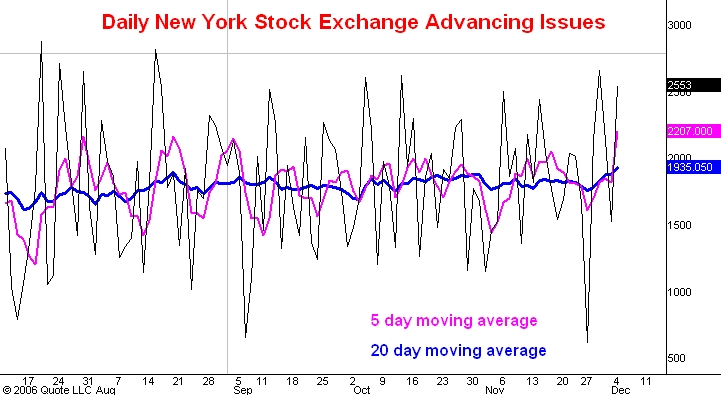
The reason is simple enough. In a bull market I have found that uptrends such as this one which began from the June-July lows do not end at the point of maximum bullish sentiment and price velocity. Instead one generally sees some visible drop-off in bullish sentiment and a "rounding over" appearance in the averages before the final top develops. One also generally sees obvious bearish divergences in the advancing issues moving averages. None of these warning signs are yet visible.
In my opinion the late November 2006 time frame will probably mark the point of maximum bullish sentiment. From this point forward I expect a sequence of more or less deep reactions followed by rallies to new bull market highs. This process will probably end sometime in the first quarter of 2007 and be followed by a 15 % break in the averages.